
Introduction
Working capital is one of the most important financial measures for any business, yet it’s often misunderstood. Whether you’re managing day-to-day expenses, investing in growth or improving cash flow, understanding how working capital works can help your business make smarter financial decisions.
Many successful UK businesses are profitable on paper but still experience cash flow challenges because income doesn’t always arrive when it’s needed. That’s where working capital finance can make a significant difference, providing businesses with the flexibility to manage short-term obligations while continuing to grow.
In this guide, we’ll explain what working capital is, how it’s calculated, why it matters and how businesses use commercial finance to strengthen cash flow. We’ll also share practical examples, common mistakes to avoid and expert tips to help you choose the right funding solution for your business.
Whether you’re an established SME or a growing company, this guide will help you understand how working capital can support long-term business success.
Contents
| Section | Purpose / Description |
|---|---|
| Introduction | Introduces the concept of working capital, explains its importance, and outlines what the guide covers. |
| What Is Working Capital? | Defines working capital and explains its role in measuring a business’s short-term financial health and liquidity. |
| Why Working Capital Matters | Explores why maintaining adequate working capital is essential for day-to-day operations, business stability, and growth. |
| How Working Capital Is Calculated | Explains the working capital formula, its components, and how businesses can interpret the results. |
| Positive vs Negative Working Capital | Compares positive and negative working capital, highlighting what each indicates about a business’s financial position. |
| How Working Capital Works in Practice | Demonstrates how businesses use working capital to manage operational expenses, inventory, receivables, and payables. |
| Why Businesses Use Working Capital Finance | Explains how working capital finance helps businesses bridge cash flow gaps, manage seasonal demand, and fund short-term needs. |
| Is Working Capital Finance Right for Every Business? | Discusses the situations where working capital finance is beneficial and when alternative funding options may be more suitable. |
| Common Working Capital Mistakes Businesses Make | Identifies common errors in managing working capital and provides practical advice for avoiding them. |
| Working Capital vs Cash Flow: What’s the Difference? | Clarifies the differences between working capital and cash flow, explaining how they work together to support business performance. |
| Frequently Asked Questions About Working Capital | Answers common questions about working capital, finance options, calculations, and best practices. |
| Conclusion: Building Stronger Working Capital for Long-Term Business Growth | Summarises the key takeaways and reinforces the importance of effective working capital management for sustainable business success. |
| References | Lists the sources, reports, and official guidance used to support the information presented in the guide. |
What Is Working Capital?
Working capital measures a business’s ability to meet its short-term financial obligations using its short-term assets. Put simply, it represents the money available to keep your business operating efficiently every day.
Current assets typically include cash held within the business, outstanding customer invoices, stock and any other assets expected to be converted into cash within twelve months. Current liabilities include supplier invoices, VAT, PAYE, Corporation Tax, overdrafts and any other financial commitments due within the same period.
The relationship between these two figures provides valuable insight into the financial health of a business. When current assets exceed current liabilities, a business generally has positive working capital, providing greater flexibility to manage unexpected costs and invest in future growth. Conversely, when liabilities outweigh available assets, businesses may find themselves under increasing financial pressure despite generating healthy levels of revenue.
For this reason, lenders, accountants and financial professionals often consider working capital to be one of the most important indicators of a company’s short-term financial position.
Why Working Capital Matters
Many business owners focus on increasing sales and improving profitability. While both are essential, they only tell part of the story. A profitable business can still experience serious financial pressure if cash isn’t available when it’s needed. This is why working capital is often considered one of the most important indicators of a company’s financial health. It shows whether a business has enough short-term resources to meet its day-to-day obligations while continuing to operate and grow.
Healthy working capital gives businesses the flexibility to pay suppliers on time, cover employee wages, purchase stock and respond to unexpected costs without disrupting normal operations. As a result, companies with strong working capital are often better positioned to seize new opportunities, negotiate better supplier terms and invest in long-term growth. Consequently, maintaining positive working capital should be a priority for businesses of every size.
By contrast, poor working capital management can quickly create cash flow challenges, even for businesses with healthy turnover. For example, a company may win several large contracts but still struggle financially because customer payments are delayed while supplier invoices and payroll must be paid immediately. Without sufficient liquidity, businesses may be forced to delay projects, decline new opportunities or rely on expensive short-term borrowing to bridge the gap.
Furthermore, lenders and investors often assess working capital when evaluating a business’s financial stability. Positive working capital demonstrates that a company is managing its finances responsibly and has the ability to meet its short-term commitments. This can improve confidence during funding applications and may increase access to more competitive business finance solutions.
Ultimately, working capital is far more than an accounting figure. It represents the financial flexibility that allows businesses to continue trading, invest with confidence and navigate periods of uncertainty. Understanding and managing working capital effectively can strengthen cash flow, improve financial resilience and create a solid foundation for sustainable business growth.
How Working Capital is Calculated
Calculating working capital is straightforward, yet it provides valuable insight into a business’s short-term financial position. The calculation compares the value of a company’s current assets with its current liabilities, helping business owners understand whether they have enough readily available resources to meet upcoming financial commitments. As a result, working capital is one of the most widely used financial metrics by accountants, lenders and business owners.
The formula is simple:
Working Capital = Current Assets − Current Liabilities
Current assets include resources that are expected to be converted into cash within the next 12 months. These typically include cash held in business bank accounts, outstanding customer invoices, inventory, stock and any other short-term assets. Current liabilities, on the other hand, represent financial obligations that are due within the same period, such as supplier invoices, VAT, PAYE, Corporation Tax, short-term borrowing and other operating expenses.
A positive result indicates that a business has sufficient short-term assets to meet its immediate financial obligations. Consequently, this usually suggests the business has greater financial flexibility, allowing it to manage cash flow effectively while continuing to invest in future growth. However, a negative result may indicate that liabilities exceed available assets, increasing the risk of cash flow pressure and making it more difficult to fund day-to-day operations.
Although the calculation itself is relatively simple, interpreting the result requires a broader understanding of the business. For example, a seasonal retailer may temporarily report lower working capital after purchasing large volumes of stock ahead of peak trading periods.
Likewise, businesses that offer extended payment terms to customers may appear to have weaker liquidity despite maintaining strong profitability. Therefore, working capital should always be considered alongside cash flow, profitability and the wider financial performance of the business.
A positive working capital position doesn’t just improve day-to-day operations. It also gives businesses greater resilience during quieter trading periods and can improve their ability to access future funding.
Likewise, understanding your working capital can help you identify opportunities to improve cash flow before financial pressure begins to build.
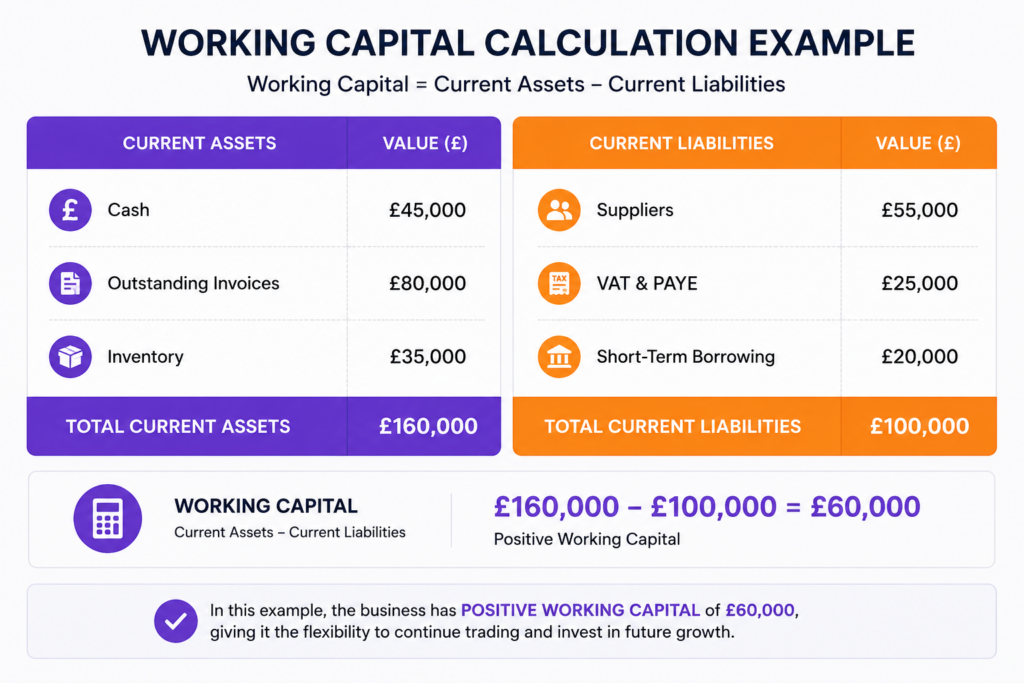
Calculation
£160,000 − £100,000 = £60,000
Working Capital = £60,000
In this example, the business has positive working capital of £60,000, meaning it has sufficient short-term assets to cover its immediate financial commitments while retaining the flexibility to continue investing in future growth
Key Takeaway
Calculating working capital is one of the quickest ways to assess a business’s short-term financial health. While a positive figure generally indicates good liquidity, the result should always be considered alongside factors such as cash flow, profitability, industry trends and future financial commitments to provide a complete picture of the business’s financial position.
Understanding the Formula
While the working capital formula is straightforward, understanding what influences current assets and current liabilities is just as important as performing the calculation itself. A single figure only provides a snapshot of your business’s financial position at a specific point in time. Therefore, business owners should also consider factors such as customer payment terms, supplier agreements, inventory levels and seasonal trading patterns when assessing their working capital. Looking at the wider financial picture helps businesses make better decisions, improve cash flow and identify opportunities to strengthen long-term financial stability.
Tip: Working capital should be reviewed regularly rather than once a year. Monitoring changes over time allows businesses to identify potential cash flow issues early, respond to changing trading conditions and make informed funding decisions before financial pressure begins to build.
Positive vs Negative Working Capital
Understanding the difference between positive and negative working capital is essential for assessing the short-term financial health of any business. While the calculation itself is straightforward, interpreting the result provides valuable insight into how effectively a business can manage its day-to-day operations, respond to unexpected expenses and invest in future growth.
A business with positive working capital has more current assets than current liabilities. In practical terms, this means the business has sufficient resources to meet its short-term financial commitments while continuing to operate efficiently. Consequently, businesses with positive working capital are generally better positioned to pay suppliers on time, maintain healthy cash flow and take advantage of new opportunities without relying heavily on external finance.
By contrast, negative working capital occurs when current liabilities exceed current assets. This may indicate that a business could struggle to meet its immediate financial obligations, particularly if customer payments are delayed or unexpected costs arise. However, negative working capital is not always a sign of financial distress. Some industries, such as supermarkets and subscription-based businesses, naturally operate with negative working capital because they receive customer payments before settling supplier invoices. Therefore, working capital should always be assessed within the context of the business model and industry.
Rather than focusing solely on whether working capital is positive or negative, business owners should aim to maintain a healthy balance that supports sustainable growth. Excessively high working capital may suggest that cash is sitting idle instead of being invested into the business, while consistently low working capital can increase financial risk and restrict future opportunities. Reviewing working capital regularly allows businesses to identify trends early and make informed financial decisions before challenges develop.
Table 1. Positive vs Negative Working Capital Comparison
| Positive Working Capital | Negative Working Capital |
|---|---|
| Current assets exceed current liabilities | Current liabilities exceed current assets |
| Stronger short-term financial position | Increased pressure on cash flow |
| Greater flexibility to invest and grow | Limited financial flexibility |
| Suppliers can be paid on time | Supplier payments may be delayed |
| Better resilience during unexpected costs | Higher reliance on external funding |
| Often viewed positively by lenders | May require closer financial management |
What Is Considered Healthy Working Capital?
There is no single figure that represents the ideal level of working capital, as requirements vary between industries and business models. For example, a manufacturing business purchasing large quantities of raw materials will typically require more working capital than a software company with relatively low operating costs.
Instead of comparing your business with others, it’s more effective to monitor trends over time. Improving working capital, maintaining positive cash flow and meeting financial commitments consistently are often stronger indicators of financial stability than achieving a specific numerical target.
Key Takeaway: Positive working capital provides businesses with the flexibility to manage day-to-day operations, invest in future growth and respond confidently to changing market conditions. Reviewing your working capital regularly can help identify potential cash flow issues before they begin to affect your business.
How Working Capital Works in Practice
Understanding working capital is much easier when you see how it applies in a real business scenario. Although every company operates differently, the underlying principle remains the same: businesses often need to spend money long before they receive payment from their customers.
Imagine a manufacturing business wins a new contract worth £300,000 to produce specialist components for a large customer. The opportunity is exciting and has the potential to increase annual revenue significantly. However, before production can begin, the business must purchase raw materials, schedule manufacturing time and pay employees responsible for delivering the project.
At the same time, the customer has agreed to settle the invoice 60 days after delivery. Consequently, the business faces a significant gap between paying its own costs and receiving payment from the customer. Even though the contract is profitable, the business still requires sufficient working capital to fund operations during this period.
Rather than delaying production or turning down the opportunity, the business uses working capital finance to bridge the gap. This provides immediate access to funds, allowing materials to be purchased, employees to be paid and production to continue without disrupting everyday operations. Once the customer settles the invoice, the facility can be repaid, allowing the business to continue trading with confidence.
This example demonstrates why cash flow and profitability are not the same thing. A business can be highly profitable while still experiencing financial pressure if customer payments are delayed. Therefore, maintaining healthy working capital enables businesses to continue operating efficiently, meet financial commitments and invest in future growth without unnecessary disruption.
Figure 1- Example Working Capital Cycle
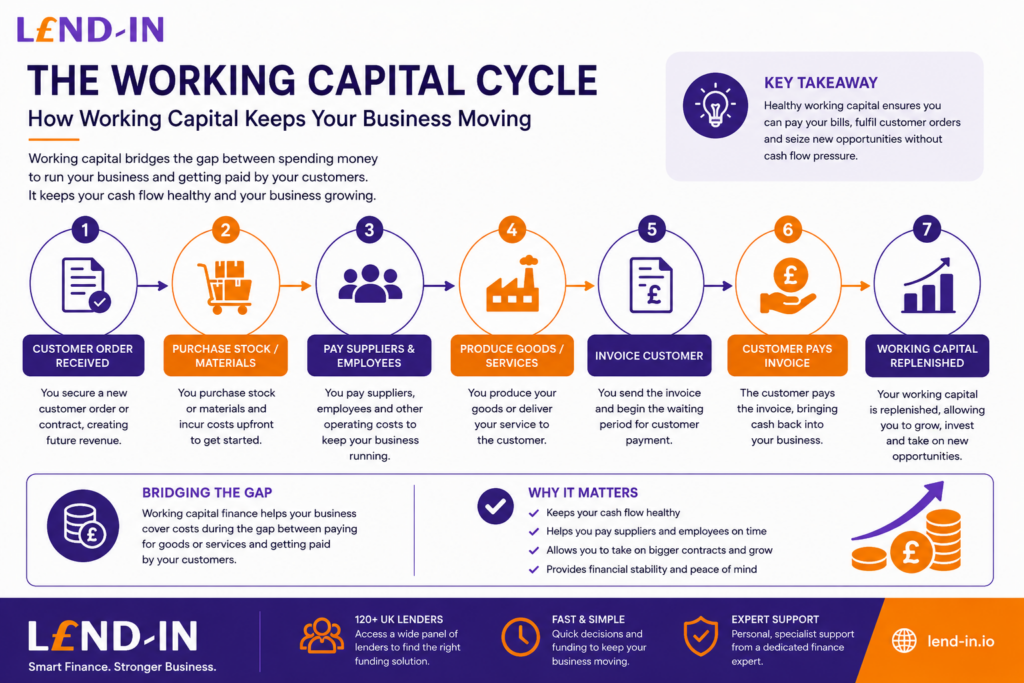
Figure 1. Illustration showing how working capital bridges the gap between business expenditure and customer payment, enabling businesses to maintain healthy cash flow while continuing to grow.
Table 2. Working Capital Steps
| Stage | What Happens? | Cash Flow Impact |
|---|---|---|
| Win a new customer contract | Future revenue is secured | No immediate cash received |
| Purchase stock or materials | Upfront business costs are incurred | Cash decreases |
| Pay suppliers and employees | Day-to-day operations continue | Working capital is utilised |
| Deliver goods or services | Customer receives the completed order | Invoice is issued |
| Customer payment received | Invoice is settled | Cash flow improves |
| Working capital replenished | Business is ready for the next opportunity | Financial position strengthens |
Table 2. Examples of stages and steps that contribute to Cash Flow Impact.
Why This Example Matters
Many growing businesses experience periods where demand is high, yet available cash is limited. This is particularly common in industries such as construction, manufacturing, wholesale, retail and engineering, where businesses often incur significant costs before receiving payment from customers.
Without sufficient working capital, companies may be forced to delay projects, negotiate extended supplier terms or decline profitable contracts altogether. Conversely, businesses with healthy working capital can respond quickly to new opportunities, strengthen supplier relationships and continue growing without placing unnecessary pressure on day-to-day operations.
For this reason, improving working capital should not be viewed simply as a financial objective. Instead, it should form part of a wider business strategy that supports sustainable growth, stronger cash flow management and long-term financial resilience.
Expert Insight
One of the most common misconceptions among business owners is that increasing turnover automatically improves cash flow. In reality, rapid growth often places greater pressure on working capital, as higher sales usually require additional stock, increased staffing and larger operational expenses before customer payments are received.
Businesses that plan ahead by regularly reviewing their working capital are often better equipped to manage growth, avoid unnecessary financial pressure and respond confidently when new opportunities arise.
Why Businesses Use Working Capital Finance
Every business experiences periods where cash leaves the business before new income arrives. Whether it’s purchasing stock, paying suppliers or investing in growth, there are often occasions when businesses need access to funds before customer payments are received. This is where working capital finance can provide valuable support.
Rather than replacing profitability, working capital finance helps businesses manage temporary cash flow gaps and maintain financial flexibility. Consequently, businesses can continue operating, invest in new opportunities and meet their financial commitments without placing unnecessary pressure on day-to-day cash flow.
Many business owners mistakenly believe that working capital finance is only used by companies experiencing financial difficulties. In reality, many successful and profitable businesses use it strategically to support growth, manage seasonal demand and improve operational efficiency. Having access to additional liquidity allows businesses to respond quickly to new opportunities without waiting for customer payments to arrive.
Common Reasons Businesses Use Working Capital Finance
Businesses use working capital finance for many different reasons, depending on their industry, trading cycle and growth plans.
Some of the most common uses include:
- Purchasing stock before busy trading periods
- Funding large customer orders
- Covering payroll and supplier payments
- Managing seasonal fluctuations in demand
- Bridging the gap between invoicing and customer payment
- Investing in marketing and business growth
- Purchasing equipment or essential materials
- Supporting business expansion
- Improving day-to-day cash flow
- Refinancing more expensive short-term borrowing
The Benefits of Working Capital Finance
When used responsibly, working capital finance can provide significant advantages for growing businesses.
Improve Cash Flow
Additional funding helps businesses meet short-term financial commitments while waiting for customer payments, reducing unnecessary pressure on everyday operations.
Support Business Growth
Businesses can accept larger contracts, purchase additional stock and invest in expansion without relying solely on existing cash reserves.
Strengthen Supplier Relationships
Paying suppliers on time can improve trust, strengthen commercial relationships and, in some cases, provide access to early payment discounts.
Increase Financial Flexibility
Access to additional liquidity enables businesses to respond more quickly to unexpected opportunities or unforeseen expenses.
Maintain Business Continuity
Healthy working capital helps businesses continue trading confidently during quieter periods, seasonal fluctuations or temporary delays in customer payments.
Is Working Capital Finance Right for Every Business?
Not every business requires working capital finance, and the most appropriate funding solution will depend on factors such as cash flow, growth objectives, trading history and future financial commitments.
Before applying for funding, business owners should assess their current financial position, review cash flow forecasts and consider whether additional funding will create long-term value for the business. In many cases, comparing multiple lenders and funding options can help identify a solution that aligns with both immediate requirements and future growth plans.
Expert Insight
One of the most common misconceptions is that businesses only seek funding when they encounter financial problems. In practice, many of the strongest businesses use working capital finance proactively to maintain momentum, improve cash flow and position themselves for sustainable growth. Having access to finance at the right time can often create opportunities rather than simply solve problems.
Table 3. How Working Capital Finance Helps UK Businesses Improve Cash Flow
| Business Challenge | How Working Capital Finance Helps |
|---|---|
| Waiting for customer payments | Bridges the cash flow gap while invoices remain outstanding. |
| Purchasing stock | Provides access to funds before peak trading periods. |
| Hiring new employees | Supports payroll during periods of business growth. |
| Winning a large contract | Covers upfront costs before customer payment is received. |
| Seasonal demand | Improves liquidity during quieter trading periods. |
| Unexpected business expenses | Helps manage unforeseen costs without disrupting operations. |
| Investing in growth | Provides additional flexibility to expand with confidence. |
Table 3. Examples of how working capital finance can help businesses overcome common cash flow challenges and support sustainable growth.
Common Working Capital Mistakes Businesses Make
Even businesses with strong sales and healthy profits can experience financial pressure if working capital is not managed effectively. Fortunately, many of the most common issues are avoidable. By recognising these challenges early, business owners can strengthen cash flow, improve financial resilience and make more informed funding decisions.
Below are some of the most common working capital management mistakes and practical ways to avoid them.
1. Focusing on Profit Instead of Cash Flow
One of the biggest misconceptions among business owners is that a profitable business will always have healthy finances. In reality, profit and cash flow are two very different measures. A business may report strong profits while still struggling to pay suppliers or employees if customer payments have not yet been received. Therefore, monitoring cash flow alongside profitability provides a more accurate picture of short-term financial health.
2. Allowing Customer Payments to Drift
Late customer payments remain one of the biggest causes of cash flow problems for UK businesses. Although offering credit terms may help secure new business, failing to monitor outstanding invoices can place unnecessary pressure on working capital. Implementing clear payment terms, issuing invoices promptly and following up overdue balances consistently can significantly improve liquidity.
3. Holding Too Much Inventory
Stock is essential for many businesses, but excessive inventory can tie up valuable cash that could be invested elsewhere. Regularly reviewing purchasing patterns and removing slow-moving stock helps release capital while reducing storage costs and improving operational efficiency.
4. Ignoring Cash Flow Forecasts
Many businesses prepare annual budgets but fail to update their cash flow forecasts throughout the year. Consequently, unexpected tax bills, seasonal fluctuations or large supplier payments can create avoidable financial pressure. Maintaining an accurate forecast allows businesses to plan ahead and identify potential funding requirements before they become urgent.
5. Relying on a Single Source of Finance
Depending entirely on one funding provider may reduce flexibility if your circumstances change. Every lender has different lending criteria, products and pricing structures. Consequently, reviewing your funding options regularly can help ensure your business continues to benefit from the most suitable commercial finance solution as it grows.
6. Waiting Too Long to Seek Funding
Many business owners only explore working capital finance when cash flow has already become a problem. However, funding applications are often stronger when a business remains financially healthy. Planning ahead gives businesses more options and reduces the pressure of making decisions during challenging trading periods.
Table 4. Common Working Capital Mistakes and Practical Solutions
| Common Mistake | Potential Impact | Recommended Solution |
|---|---|---|
| Focusing only on profit | Cash shortages despite healthy sales | Monitor both profit and cash flow regularly |
| Late customer payments | Reduced liquidity | Improve credit control and invoice promptly |
| Holding excessive inventory | Cash tied up in stock | Review inventory levels frequently |
| Poor cash flow forecasting | Unexpected financial pressure | Update forecasts monthly |
| Using only one lender | Reduced funding flexibility | Compare funding options regularly |
| Delaying funding decisions | Limited financial options | Plan funding requirements in advance |
Table 4. Common working capital management mistakes and practical solutions that can help UK businesses strengthen cash flow and improve financial stability.
Expert Insight
Successful businesses rarely manage working capital by chance. Instead, they review their financial position regularly, monitor cash flow closely and plan ahead for future investment opportunities. Small improvements made consistently over time can have a significant impact on liquidity, business resilience and long-term growth.
Key Takeaway
Managing working capital effectively is not simply about reducing costs or increasing sales. Instead, it involves maintaining the right balance between income, expenditure and future investment. Businesses that monitor their financial performance proactively are often better positioned to manage uncertainty, seize growth opportunities and build a more resilient business.
Working Capital vs Cash Flow: What’s the Difference?
Although the terms working capital and cash flow are often used interchangeably, they measure two different aspects of a business’s financial health. Understanding the distinction is essential for making informed financial decisions, improving liquidity and selecting the right business finance solution.
Working capital measures the difference between a business’s current assets and current liabilities at a specific point in time. In contrast, cash flow measures the movement of money into and out of the business over a period of time. Consequently, a business can have positive working capital while experiencing temporary cash flow challenges, or strong cash flow despite lower working capital.
For example, a business may issue several large customer invoices during the month. Although these invoices increase current assets and improve working capital, the cash has not yet been received. Until customers settle those invoices, the business may still experience pressure when paying suppliers, wages or other operating expenses. Therefore, monitoring both working capital and cash flow provides a far more accurate picture of a company’s financial position than relying on either metric alone.
Rather than viewing these measures separately, successful businesses manage them together. Healthy working capitalsupports day-to-day operations, while strong cash flow ensures money continues moving efficiently throughout the business. Together, they provide the financial stability needed to invest confidently, manage risk and support sustainable growth.
Table 5. Working Capital vs Cash Flow
| Working Capital | Cash Flow |
|---|---|
| Measures short-term financial position | Measures the movement of cash over time |
| Based on current assets and current liabilities | Based on money entering and leaving the business |
| Provides a snapshot at a specific point in time | Demonstrates financial performance over a period |
| Indicates ability to meet short-term obligations | Indicates the availability of cash to operate daily |
| Used to assess liquidity | Used to assess operational cash management |
| Influenced by invoices, inventory and liabilities | Influenced by customer payments, supplier payments and operating expenses |
Table 5. A comparison of working capital and cash flow, highlighting how each financial measure provides different insights into the short-term financial health of a business.
Why Both Measures Matter
Businesses rarely succeed by monitoring a single financial metric. While working capital helps assess whether sufficient short-term resources are available, cash flow determines whether the business has enough available cash to meet its immediate financial commitments. Consequently, reviewing both figures together enables business owners to identify potential challenges earlier and make more informed financial decisions.
For example, a company may report positive working capital because it holds significant customer invoices. However, if those invoices remain unpaid for several weeks, the business may still struggle to pay suppliers or employees. Conversely, a business with strong cash flow may continue operating comfortably despite temporarily lower working capital. Understanding these differences allows business owners to respond proactively rather than reactively.
Key Takeaway
Although working capital and cash flow are closely connected, they should never be considered interchangeable. Monitoring both financial measures provides a more complete understanding of your business’s liquidity, financial resilience and ability to support sustainable growth.
Expert Insight
One of the most common reasons profitable businesses experience financial pressure is that they focus exclusively on profit and overlook cash flow and working capital. Successful businesses review all three together, allowing them to identify potential issues early, improve liquidity and make better long-term financial decisions.
Conclusion
Maintaining healthy working capital is essential for businesses that want to operate efficiently, strengthen cash flow and achieve sustainable growth. While the calculation itself is straightforward, understanding how working capital influences day-to-day operations can help business owners make more informed financial decisions and prepare for future opportunities.
Throughout this guide, we’ve explored how working capital is calculated, why it matters, how it differs from cash flow, and the practical steps businesses can take to improve their financial position. Whether you’re managing seasonal demand, funding larger customer orders or planning your next stage of growth, maintaining sufficient liquidity can help your business remain resilient in an increasingly competitive marketplace.
Although every business has unique financial requirements, one principle remains consistent: proactively managing working capital places businesses in a stronger position to meet short-term obligations, invest with confidence and respond quickly to new opportunities. Consequently, regularly reviewing your financial position and planning ahead can reduce unnecessary financial pressure while supporting long-term success.
If you’re exploring ways to improve working capital, business finance or commercial finance, comparing multiple funding options can help you identify a solution that aligns with your objectives. At Lend-In, we compare funding solutions from 120+ UK lenders, helping businesses explore competitive finance options that support growth, improve liquidity and strengthen cash flow through a transparent and straightforward process.
Explore Business Finance with Confidence
Whether you’re looking to improve working capital, strengthen cash flow or fund your next stage of growth, our team is here to help. With access to 120+ UK lenders, Lend-In compares a wide range of business finance and commercial finance solutions, helping you identify funding options tailored to your business.
Ready to explore your options? Get in touch with the Lend-In team today and discover how the right funding solution could support your business.
Frequently Asked Questions About Working Capital
Working capital is the difference between a business’s current assets and current liabilities. It measures whether a business has enough short-term resources to meet its immediate financial obligations, such as paying suppliers, employees and operating expenses. Maintaining healthy working capital helps businesses improve cash flow, manage day-to-day operations and invest confidently in future growth.
Working capital is important because it helps businesses operate smoothly without unnecessary financial pressure. Healthy working capital enables companies to pay suppliers on time, purchase inventory, manage payroll and respond to unexpected expenses. Consequently, businesses with strong working capital are often better positioned to maintain positive cash flow, support sustainable growth and seize new commercial opportunities.
Working capital is calculated by subtracting current liabilities from current assets.
Working Capital = Current Assets − Current Liabilities
Current assets typically include cash, outstanding customer invoices and inventory, while current liabilities include supplier invoices, taxes and short-term borrowing. A positive result generally indicates stronger short-term financial health.
There is no single figure that defines good working capital, as every business has different financial requirements. However, positive working capital usually indicates that a business has sufficient short-term assets to meet its immediate liabilities. The ideal level depends on factors such as industry, trading cycle, operating costs and future growth plans.
Yes. A business can generate healthy profits while still experiencing poor working capital if customer payments are delayed or cash is tied up in inventory. This is why businesses should monitor working capital, cash flow and profitability together rather than relying on a single financial measure.
Poor working capital can result from several factors, including late customer payments, excessive inventory, rising operating costs, weak cash flow forecasting or rapidly increasing business expenses. Identifying these issues early allows businesses to take practical steps to improve liquidity and strengthen their overall financial position.
Businesses can improve working capital by encouraging faster customer payments, negotiating supplier payment terms, managing inventory efficiently, reducing unnecessary costs and strengthening cash flow forecasting. In some cases, working capital finance may also provide additional flexibility to support business operations and growth.
Working capital finance provides businesses with access to funds that help cover short-term operating expenses while waiting for customer payments. Businesses commonly use this type of finance to purchase stock, fund payroll, manage seasonal demand or support larger customer orders without disrupting cash flow.
No. Although they are closely related, working capital and cash flow measure different aspects of a business’s financial health. Working capital provides a snapshot of short-term liquidity at a specific point in time, whereas cash flow measures the movement of money into and out of the business over a defined period.
Yes. Many lenders review working capital as part of their underwriting process because it provides valuable insight into a business’s ability to meet its short-term financial commitments. Healthy working capital may strengthen a funding application and demonstrate sound financial management.
Most businesses benefit from healthy working capital, although industries with longer payment cycles often rely on it more heavily. Construction, manufacturing, wholesale, retail, logistics, engineering and healthcare businesses frequently require strong working capital to manage upfront costs before customer payments are received.
Businesses should review working capital regularly rather than only at year-end. Monthly reviews allow business owners to monitor liquidity, identify cash flow trends and respond quickly to changing financial circumstances. Regular monitoring also supports better financial planning and more informed business decisions.
Yes. Although positive working capital is generally beneficial, holding excessive cash or inventory may indicate that resources are not being used efficiently. Businesses should aim to maintain a healthy balance by investing surplus funds where appropriate while ensuring sufficient liquidity to meet short-term obligations.
At Lend-In, we compare funding solutions from 120+ UK lenders, helping businesses explore working capital finance, business loans and other commercial finance options tailored to their objectives. By comparing multiple lenders through a single application, businesses can identify funding solutions that strengthen cash flow, improve liquidity and support sustainable growth.
References
The information contained in this guide has been prepared using publicly available guidance, financial reporting standards and industry research from recognised UK organisations.
1. British Business Bank. Small Business Finance Markets Report. Available at: https://www.british-business-bank.co.uk
2. Bank of England. Credit Conditions Survey and Monetary Policy Reports. Available at: https://www.bankofengland.co.uk
3. UK Finance. Business Finance and Lending Publications. Available at: https://www.ukfinance.org.uk
4. Financial Conduct Authority (FCA). Financial Services Guidance and Consumer Protection. Available at: https://www.fca.org.uk
5. Office for National Statistics (ONS). UK Business, Industry and Economic Statistics. Available at: https://www.ons.gov.uk
6. HM Revenue & Customs (HMRC). Guidance for Businesses and Employers. Available at: https://www.gov.uk/government/organisations/hm-revenue-customs
7. Department for Business and Trade. Support for UK Businesses and SMEs. Available at: https://www.gov.uk/government/organisations/department-for-business-and-trade
8. Companies House. Official UK Company Information. Available at: https://www.gov.uk/government/organisations/companies-house