Introduction
For many UK businesses, investing in new equipment, machinery or vehicles is essential for growth. Whether expanding production, replacing ageing assets or improving operational efficiency, purchasing high-value equipment outright can place significant pressure on cash flow.
Asset finance provides an alternative by allowing businesses to spread the cost of essential assets over an agreed period rather than making a substantial upfront payment. This enables companies to preserve working capital while accessing the equipment they need to operate, compete and grow.
From construction machinery and manufacturing equipment to commercial vehicles, medical technology and office infrastructure, asset finance supports businesses across a wide range of industries. By matching repayment structures to business cash flow, it helps organisations invest with greater confidence while maintaining financial flexibility.
However, choosing the right asset finance solution involves more than comparing monthly repayments. Different lenders offer varying products, eligibility criteria and contract terms, while options such as hire purchase, finance leases and operating leases are designed to meet different commercial objectives.
This guide explains how asset finance works, explores the most common funding options available to UK businesses and outlines the key factors to consider before making an investment decision. By understanding the market and comparing lenders carefully, businesses can identify funding solutions that support both short-term operational requirements and long-term growth.
✅ Key Takeaways
- Asset finance enables businesses to acquire equipment, machinery and vehicles without paying the full cost upfront.
- Common asset finance products include hire purchase, finance leases and operating leases.
- Preserving working capital allows businesses to invest in growth while maintaining healthy cash flow.
- Every lender has different eligibility criteria, pricing models and repayment structures.
- Comparing multiple lenders can help businesses identify funding that best aligns with their commercial objectives.
Contents
| Section | Topic |
|---|---|
| 1 | Introduction |
| 2 | Key Takeaways |
| 3 | What Is Asset Finance? |
| 4 | How Asset Finance Works |
| 5 | Types of Asset Finance |
| 6 | Why Businesses Use Asset Finance |
| 7 | Benefits of Asset Finance |
| 8 | Figure 1. Illustrative Asset Finance Journey |
| 9 | How Lenders Assess Asset Finance Applications |
| 10 | Common Reasons Asset Finance Applications Are Declined |
| 11 | Asset Finance Checklist |
| 12 | Figure 2. Asset Finance Decision Framework |
| 13 | Asset Finance vs Business Loans |
| 14 | How Lend-In Helps Businesses Compare Asset Finance |
| 15 | Frequently Asked Questions |
| 16 | Conclusion |
| 17 | Continue Your Learning |
| 18 | References |
What Is Asset Finance?
Asset finance is a form of business finance that enables companies to acquire essential assets without paying the full purchase price upfront. Instead of making a significant one-off investment, businesses spread the cost over an agreed period through manageable repayments, helping to preserve cash flow while investing in growth.
UK businesses use asset finance to fund a wide variety of business-critical assets, including commercial vehicles, construction equipment, manufacturing machinery, agricultural equipment, medical technology, IT infrastructure and office equipment. Rather than delaying investment until sufficient capital is available, businesses can access the assets they need immediately while spreading the cost over time.
Unlike a traditional business loan, where funding is usually provided as a lump sum for general business purposes, asset finance is specifically linked to the purchase or use of a particular asset. Depending on the finance agreement, the asset itself may also act as security, which can make this type of funding accessible for businesses across many sectors.
One of the primary advantages of asset finance is that it allows businesses to preserve working capital. Instead of tying up valuable cash reserves in expensive purchases, businesses can retain liquidity for day-to-day operations, recruitment, stock purchases and future investment opportunities.
As a result, asset finance has become one of the UK’s most widely used funding solutions for businesses looking to modernise equipment, improve productivity and support sustainable long-term growth.
Which Assets Can Be Financed?
Asset finance can be used to fund a broad range of business assets, including:
- Commercial vehicles
- Cars and company fleets
- HGVs and transport vehicles
- Construction machinery
- Manufacturing equipment
- Agricultural machinery
- Medical and dental equipment
- Engineering equipment
- Printing equipment
- Renewable energy systems
- IT hardware and servers
- Office furniture and equipment
- Catering and hospitality equipment
- Warehousing and logistics equipment
Because asset finance covers such a wide variety of equipment, it is commonly used by businesses operating in sectors such as construction, manufacturing, healthcare, logistics, engineering, retail, hospitality and agriculture.
💡 Did You Know?
Asset finance is one of the most widely used forms of business funding in the UK because it allows businesses to invest in equipment and machinery while preserving cash flow for day-to-day operations and future growth opportunities.
⭐ Expert Tip
Before comparing lenders, identify whether owning the asset at the end of the agreement is important to your business. Your answer can help determine whether hire purchase, a finance lease or another asset finance solution is likely to be the most suitable option.
✅ Key Takeaway
Asset finance enables businesses to access essential equipment without paying the full purchase price upfront. By spreading the cost over time, companies can preserve working capital, improve operational efficiency and invest in long-term growth while maintaining healthy cash flow.
Figure. 1 Illustrative Asset Finance Journey
This illustration demonstrates how asset finance enables UK businesses to acquire essential equipment without paying the full purchase price upfront. By spreading repayments over an agreed period, businesses can preserve working capital, maintain healthy cash flow and invest in assets that support long-term growth.
Business Identifies Equipment Requirement
                    │
                    ▼
Select Suitable Asset
                    │
                    ▼
Submit Asset Finance Application
                    │
                    ▼
Lender Reviews Application
                    │
                    ▼
Finance Approved
                    │
                    ▼
Equipment Purchased
                    │
                    ▼
Business Uses Asset
                    │
                    ▼
Monthly Repayments
                    │
                    ▼
Agreement Ends
                    │
          ┌─────────┴─────────┐
          ▼                   ▼
Business Owns Asset     Asset Returned
(Hire Purchase)        (Operating Lease)
How Asset Finance Works
Understanding how asset finance works can help businesses choose a funding solution that supports both their operational requirements and long-term financial objectives. Although individual products vary, the overall process follows a similar journey from identifying an asset to completing the finance agreement.
Rather than paying the full purchase price upfront, businesses spread the cost of an asset over an agreed repayment period. This allows organisations to acquire essential equipment while preserving working capital for other business priorities, such as recruitment, inventory or future investment.
The asset finance process typically begins when a business identifies equipment, machinery or vehicles required to support its operations. After selecting a suitable asset, the business submits an application to a lender or finance provider.
The lender then assesses several factors, including the business’s financial performance, affordability, trading history and the value of the asset being financed. Depending on the product selected, the asset itself may also provide security for the agreement.
Once approved, the finance provider purchases the asset or provides funding for its acquisition. The business can begin using the equipment immediately while making regular repayments over the agreed term.
At the end of the agreement, the outcome depends on the type of asset finance selected. Under a hire purchaseagreement, ownership typically transfers to the business once all repayments have been made. Under a finance lease or operating lease, different options may be available, including continuing the lease, upgrading equipment or returning the asset.
This structured approach enables businesses to invest in essential assets without placing unnecessary pressure on cash flow, making asset finance one of the most practical funding solutions for organisations seeking to expand, modernise or improve operational efficiency.
Why Businesses Choose Asset Finance
Many businesses choose asset finance because it provides greater financial flexibility than purchasing expensive equipment outright.
Common reasons include:
- Preserving working capital.
- Avoiding significant upfront expenditure.
- Accessing newer equipment and technology.
- Matching repayments to business cash flow.
- Supporting business growth without delaying investment.
- Improving productivity and operational efficiency.
- Replacing ageing machinery or vehicles.
For businesses operating in fast-moving industries, asset finance can provide access to modern equipment while reducing the financial impact of large capital purchases.
💡 Did You Know?
Many UK businesses use asset finance not because they cannot afford to buy equipment outright, but because preserving cash flow often provides greater financial flexibility for future investment and day-to-day operations.
⭐ Expert Tip
Before choosing an asset finance product, consider not only the monthly repayments but also whether you intend to own the asset at the end of the agreement. This simple question can help determine which type of finance best aligns with your long-term business objectives.
✅ Key Takeaway
Asset finance provides businesses with immediate access to essential equipment while spreading the cost over time. By improving affordability and protecting working capital, it enables businesses to invest confidently in assets that support sustainable growth.
Types of Asset Finance
Not all asset finance products work in the same way. Although each solution helps businesses spread the cost of acquiring equipment, machinery or vehicles, the ownership structure, repayment terms and flexibility vary depending on the agreement.
Choosing the right type of asset finance is therefore an important business decision. The most suitable option depends on factors such as whether you intend to own the asset, how long you expect to use it and the role it plays within your business operations.
The three most common forms of asset finance used by UK businesses are Hire Purchase, Finance Lease and Operating Lease.
Understanding how each product works can help businesses compare funding solutions more effectively and select finance that aligns with both operational requirements and long-term growth plans.
Figure 2. Choosing the Right Asset Finance Solution
This decision framework helps UK businesses identify the most appropriate type of asset finance based on how they intend to use an asset. By understanding whether ownership, flexibility or regular equipment upgrades are the priority, businesses can compare finance solutions more effectively and make informed funding decisions.
Need equipment, machinery or vehicles?
                 │
                 ▼
Do you want to own the asset?
         │                │
        YES              NO
         │                │
         ▼                ▼
Hire Purchase     Will you regularly
                  replace the asset?
                       │        │
                      YES      NO
                       │        │
                       ▼        ▼
                Operating   Finance
                  Lease      Lease
Hire Purchase
Hire Purchase (HP) is one of the most widely used forms of asset finance in the UK. It enables businesses to acquire equipment immediately while spreading the purchase cost over fixed monthly repayments.
During the agreement, the finance provider usually retains legal ownership of the asset. Once all repayments have been made and any final option-to-purchase fee has been settled, ownership typically transfers to the business.
Hire Purchase is commonly chosen by businesses intending to keep equipment for many years, making it particularly suitable for commercial vehicles, manufacturing machinery, agricultural equipment and construction plant.
Best suited for:
- Commercial vehicles
- Construction equipment
- Manufacturing machinery
- Agricultural machinery
- Long-term business assets
Finance Lease
A Finance Lease allows businesses to use an asset without immediately purchasing it.
The finance provider owns the asset while the business pays regular rentals for its use throughout the lease period. At the end of the agreement, ownership does not usually transfer. Instead, businesses may extend the lease, upgrade equipment or agree an alternative arrangement with the finance provider.
Finance leases are often used where businesses require long-term access to valuable equipment while maintaining greater financial flexibility.
Best suited for:
- Manufacturing equipment
- Medical equipment
- Engineering machinery
- Technology infrastructure
- Specialist equipment
Operating Lease
An Operating Lease is designed for businesses that regularly replace equipment or prefer not to own assets outright.
The agreement generally covers a shorter period than the asset’s expected lifespan. Once the lease ends, the equipment is typically returned to the finance provider and replaced with newer models if required.
Operating leases are particularly popular where technology changes rapidly or where businesses prefer predictable operating costs without concerns over future resale values.
Best suited for:
- Company vehicle fleets
- IT equipment
- Office technology
- Photocopiers
- Telecommunications equipment
Table 1. Comparing the Main Types of Asset Finance
| Feature | Hire Purchase | Finance Lease | Operating Lease |
|---|---|---|---|
| Ownership at end | Usually transferred | Usually retained by finance provider | Returned to provider |
| Monthly repayments | ✔ | ✔ | ✔ |
| Suitable for long-term ownership | ✔ | Sometimes | No |
| Equipment upgrades | Limited | Possible | Excellent |
| Preserves working capital | ✔ | ✔ | ✔ |
| Common business use | Vehicles & machinery | Specialist equipment | Technology & vehicle fleets |
Table 1. Comparison of the three most common asset finance products available to UK businesses.
💡 Did You Know?
Two businesses purchasing the same equipment may choose completely different asset finance products depending on whether they want to own the asset, upgrade it regularly or simply use it for a fixed period.
⭐ Expert Tip
Don’t choose an asset finance product based solely on the monthly repayment. Consider the total cost of ownership, equipment lifespan, maintenance requirements and whether the asset is likely to become obsolete during the agreement.
✅ Key Takeaway
Every asset finance product has a different purpose. Understanding the differences between Hire Purchase, Finance Lease and Operating Lease enables businesses to choose funding that supports their operational requirements, preserves cash flow and aligns with their long-term investment strategy.
Choosing the right Asset Finance Solution
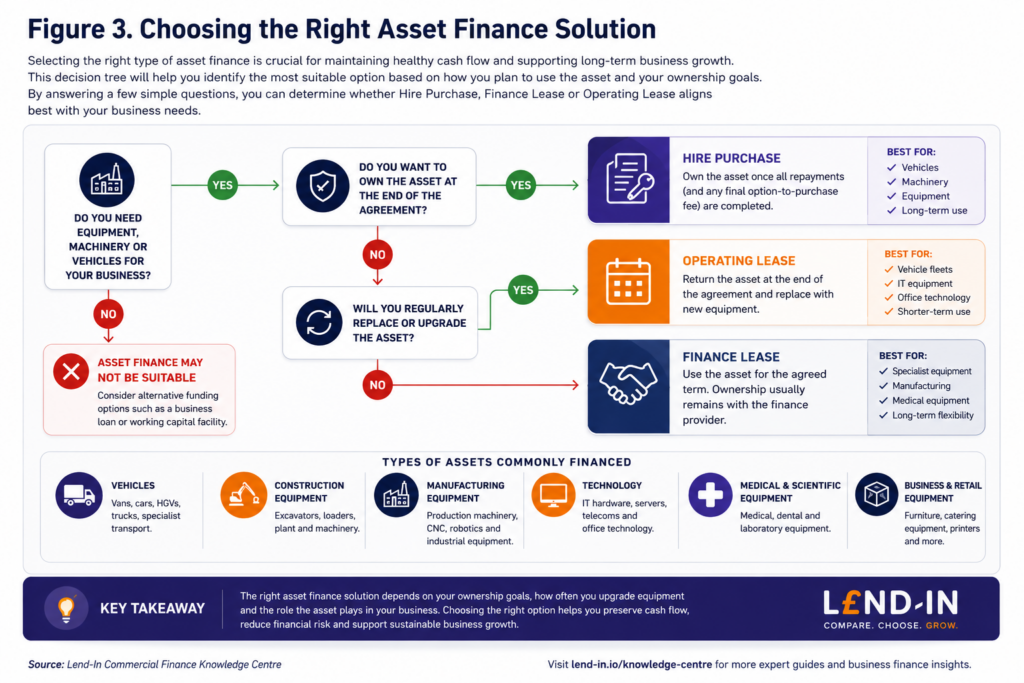
Selecting the right asset finance solution is one of the most important financial decisions a business can make when investing in equipment, machinery or commercial vehicles. While Hire Purchase, Finance Lease and Operating Leaseall allow businesses to spread the cost of acquiring assets, each funding solution is designed to support different commercial objectives.
The most suitable option depends on several factors, including whether your business intends to own the asset, how frequently the equipment is likely to be replaced and the role the asset will play within your day-to-day operations. Understanding these considerations before applying can help businesses compare finance products more effectively while avoiding unsuitable agreements or unnecessary costs.
For example, businesses purchasing long-term assets such as manufacturing machinery, construction equipment or specialist vehicles often prefer Hire Purchase, where ownership usually transfers once all repayments have been completed. Organisations that regularly upgrade technology, commercial vehicle fleets or specialist equipment may benefit from the flexibility offered by an Operating Lease. Meanwhile, businesses seeking long-term access to valuable assets without immediate ownership frequently consider a Finance Lease.
Rather than focusing solely on monthly repayments, businesses should also consider ownership, contract flexibility, maintenance responsibilities, future upgrade requirements and the overall value the finance agreement provides throughout its lifetime.
Ultimately, choosing the right asset finance solution is about selecting funding that supports your wider business strategy while preserving working capital, improving operational efficiency and enabling sustainable long-term growth.
Figure 3. Choosing the Right Asset Finance Solution
This decision framework illustrates how UK businesses can identify the most appropriate asset finance solution based on their funding objectives. By understanding whether ownership, flexibility or regular equipment upgrades are the priority, businesses can compare Hire Purchase, Finance Lease and Operating Lease more effectively while selecting funding that aligns with their long-term commercial strategy.
Key Factors to Consider Before Choosing Asset Finance
Before selecting an asset finance product, ask yourself the following questions:
- Do you want to own the asset when the agreement ends?
- How long will the asset remain useful to your business?
- Will the equipment require regular upgrades or replacement?
- Can your business comfortably afford the monthly repayments?
- Would preserving working capital benefit future growth?
- Have you compared multiple lenders before making a decision?
- Are there any additional fees, maintenance obligations or early settlement charges?
Answering these questions before applying can help businesses identify the most appropriate funding solution while improving confidence throughout the decision-making process.
💼 Real-World Example
Imagine a construction company purchasing a £180,000 excavator that it expects to use for the next ten years. Because long-term ownership is the priority, Hire Purchase may provide the most suitable solution.
By contrast, a growing technology business replacing laptops and IT equipment every three years may benefit more from an Operating Lease, allowing regular upgrades without the responsibility of owning depreciating assets.
Although both businesses require asset finance, the most suitable product depends on how the asset will be used, rather than its purchase price.
💡 Did You Know?
Asset finance is used by businesses of all sizes across the UK, from sole traders purchasing a single van to manufacturers investing millions of pounds in production machinery. The funding structure chosen often depends on business objectives rather than the value of the asset itself.
⭐ Expert Tip
Start by identifying why your business needs the asset before comparing finance products. Once your commercial objective is clear, it becomes much easier to determine whether ownership, flexibility or regular equipment replacement should influence your decision.
✅ Key Takeaway
The right asset finance solution should support both your immediate operational requirements and your long-term business strategy. By comparing ownership options, affordability, flexibility and lender terms, businesses can make informed funding decisions that protect cash flow while supporting sustainable growth.
How Lenders Assess Asset Finance Applications
Every lender has its own underwriting process when assessing an asset finance application. Although the exact criteria vary between finance providers, most lenders evaluate a combination of financial performance, affordability, business stability and the asset being financed before making a lending decision.
Unlike many unsecured funding products, asset finance is directly linked to a specific piece of equipment, machinery or a commercial vehicle. Because the asset itself often provides security for the agreement, lenders assess both the business and the value of the asset before determining whether to approve an application.
Rather than focusing on a single factor, lenders typically build an overall picture of the business to understand its ability to maintain repayments throughout the finance agreement. Businesses that demonstrate strong financial management, consistent trading and a clear commercial purpose are generally viewed more favourably during the assessment process.
Although every application is different, preparing accurate information and comparing multiple lenders can significantly improve the likelihood of identifying a funding solution that aligns with your business requirements.
Key Factors Lenders Consider
Most lenders assess a combination of the following factors when reviewing an asset finance application:
- Business turnover and profitability.
- Cash flow and affordability.
- Time spent trading.
- Existing borrowing commitments.
- Business and director credit history.
- Industry sector.
- The type, age and value of the asset.
- Deposit available (where applicable).
- Purpose of the asset purchase.
- Overall financial stability.
While one lender may place greater emphasis on trading history, another may focus more heavily on affordability or the asset itself. This is one reason why comparing multiple lenders often provides businesses with a broader range of funding opportunities.
Table 2. Key Factors Lenders Consider When Assessing Asset Finance Applications
| Assessment Area | Why It Matters |
|---|---|
| Business Performance | Demonstrates financial stability and trading strength. |
| Cash Flow | Shows the business can comfortably afford repayments. |
| Credit History | Helps lenders assess previous borrowing behaviour. |
| Trading History | Indicates operational experience and business stability. |
| Asset Value | Determines the lender’s security position. |
| Industry Sector | Some sectors carry different lending risks. |
| Existing Borrowing | Helps assess overall affordability. |
| Deposit (if applicable) | May reduce lender risk and improve available terms. |
Table 2. Key factors commonly considered during an asset finance application.
Figure 4. How Lenders Assess Asset Finance Applications
This illustration demonstrates the typical underwriting process used by lenders when assessing an asset finance application. By reviewing financial performance, affordability, the asset being financed and overall business stability, lenders determine whether the proposed finance agreement is suitable for both the business and the finance provider.
Application Submitted
          │
          ▼
Business Information Reviewed
          │
          ▼
Financial Performance Assessed
          │
          ▼
Asset Valuation
          │
          ▼
Affordability Assessment
          │
          ▼
Credit & Risk Review
          │
          ▼
Funding Decision
💼 Real-World Example
Two engineering businesses may apply to finance the same CNC machine.
Although both businesses have similar turnover, one has stronger cash flow and fewer existing borrowing commitments.
As a result, one lender may offer more competitive repayment terms, while another lender may approve only one of the applications.
This demonstrates why comparing multiple lenders can be valuable, as every finance provider applies different underwriting criteria.
📊 Industry Insight
Asset finance providers assess far more than annual turnover alone. Factors such as affordability, cash flow, trading history and the value of the asset all contribute to the overall lending decision. A well-prepared application gives lenders a clearer understanding of the business and its funding requirements.
⭐ Expert Tip
Before applying, ensure your latest business bank statements, filed accounts and management information are accurate and up to date. Providing complete and consistent information can help reduce delays and give lenders greater confidence during the assessment process.
✅ Key Takeaway
Every lender assesses asset finance applications differently. Preparing accurate financial information, demonstrating affordability and comparing multiple lenders can improve the likelihood of securing funding that supports your business objectives.
How to improve your chances of Asset Finance Approval
Preparing an asset finance application before approaching lenders can significantly improve both the quality of the application and the likelihood of securing suitable funding. Although every lender has different underwriting criteria, businesses that provide accurate financial information, demonstrate affordability and clearly explain their funding requirements are often better positioned during the assessment process.
Rather than viewing an asset finance application as simply completing a form, businesses should approach it as an opportunity to demonstrate financial stability, responsible borrowing and a clear commercial purpose. A well-prepared application can reduce unnecessary delays, strengthen lender confidence and improve the range of funding options available.
The following practical steps can help businesses improve their chances of securing asset finance while identifying funding that supports long-term commercial objectives.
Keep Financial Information Up to Date
Accurate financial information is one of the strongest indicators of a well-managed business. Before applying, ensure that annual accounts, management accounts and recent business bank statements are complete and up to date.
Providing organised financial records enables lenders to assess affordability more efficiently while demonstrating strong financial management.
Clearly Explain the Purpose of the Asset
Lenders want to understand how the equipment or machinery will benefit the business.
Whether the asset will improve productivity, increase capacity, replace ageing equipment or support business expansion, explaining the commercial purpose helps lenders understand how the investment supports future growth.
Demonstrate Affordability
Affordability remains one of the most important considerations during the underwriting process.
Businesses should ensure that monthly repayments can be comfortably supported alongside existing operating costs and borrowing commitments. Choosing a repayment structure that aligns with projected cash flow can improve financial flexibility throughout the agreement.
Compare Multiple Asset Finance Providers
Every finance provider has different lending criteria, sector expertise and product features.
Comparing multiple lenders gives businesses access to a broader range of funding options while increasing the likelihood of finding an agreement that matches their financial position and commercial objectives.
Prepare Supporting Documentation
Submitting complete documentation at the beginning of the application process can reduce delays and improve communication with lenders.
Businesses are commonly asked to provide:
- Recent business bank statements.
- Filed annual accounts.
- Management accounts where available.
- Details of existing finance agreements.
- Quotations for the asset being purchased.
- Director identification.
- Information explaining how the asset will support the business.
Preparing these documents in advance helps lenders review applications more efficiently.
Figure 5. Building a Strong Asset Finance Application
This illustration demonstrates the five key stages of preparing a successful asset finance application. By organising financial information, defining the funding requirement, demonstrating affordability, comparing lenders and submitting complete documentation, businesses can improve the quality of their application while increasing the likelihood of securing suitable funding.
Financial Preparation
          │
          ▼
Funding Requirement
          │
          ▼
Affordability Review
          │
          ▼
Compare Asset Finance Providers
          │
          ▼
Submit Complete Application
Table 3. Practical Ways to Improve an Asset Finance Application
| Action | Why It Improves Your Application |
|---|---|
| Keep financial records up to date | Helps lenders assess affordability efficiently. |
| Clearly explain the purpose of the asset | Demonstrates a genuine commercial objective. |
| Review affordability before applying | Shows repayments are sustainable. |
| Compare multiple lenders | Improves access to suitable funding solutions. |
| Prepare supporting documents | Reduces underwriting delays. |
| Seek professional guidance | Helps identify the most appropriate asset finance solution. |
Table 3. Practical steps businesses can take to strengthen an asset finance application.
💼 Real-World Example
A manufacturing business requires a £250,000 CNC machine to increase production capacity following a rise in customer demand.
Before approaching lenders, the business prepares its latest annual accounts, six months of business bank statements, management accounts and a supplier quotation for the equipment. It also explains how the investment will increase output and improve operational efficiency.
By presenting a clear commercial case alongside accurate financial information, the business improves its chances of securing competitive asset finance terms while reducing delays during the application process.
📊 Industry Insight
Businesses that prepare supporting information before applying often experience a smoother funding journey. Clear financial records, a defined funding objective and complete documentation allow lenders to assess applications more efficiently and reduce the need for additional information requests.
⭐ Expert Tip
Don’t wait until funding becomes urgent. Preparing financial information and comparing lenders before equipment is urgently required gives businesses greater flexibility, stronger negotiating power and more time to choose the most appropriate asset finance solution.
✅ Key Takeaway
Strong asset finance applications begin long before the application form is submitted. Careful preparation, accurate financial information and a clearly defined business objective can improve lender confidence while helping businesses secure funding that supports sustainable long-term growth.
Common Asset Finance Myths Explained
Despite being one of the UK’s most widely used forms of business funding, asset finance is often misunderstood. Many business owners assume it is only suitable for large organisations or believe ownership, deposits and eligibility work the same way across every finance agreement.
In reality, asset finance products vary considerably between lenders and finance providers. Understanding the facts behind these common misconceptions can help businesses make better-informed funding decisions while identifying solutions that genuinely support their commercial objectives.
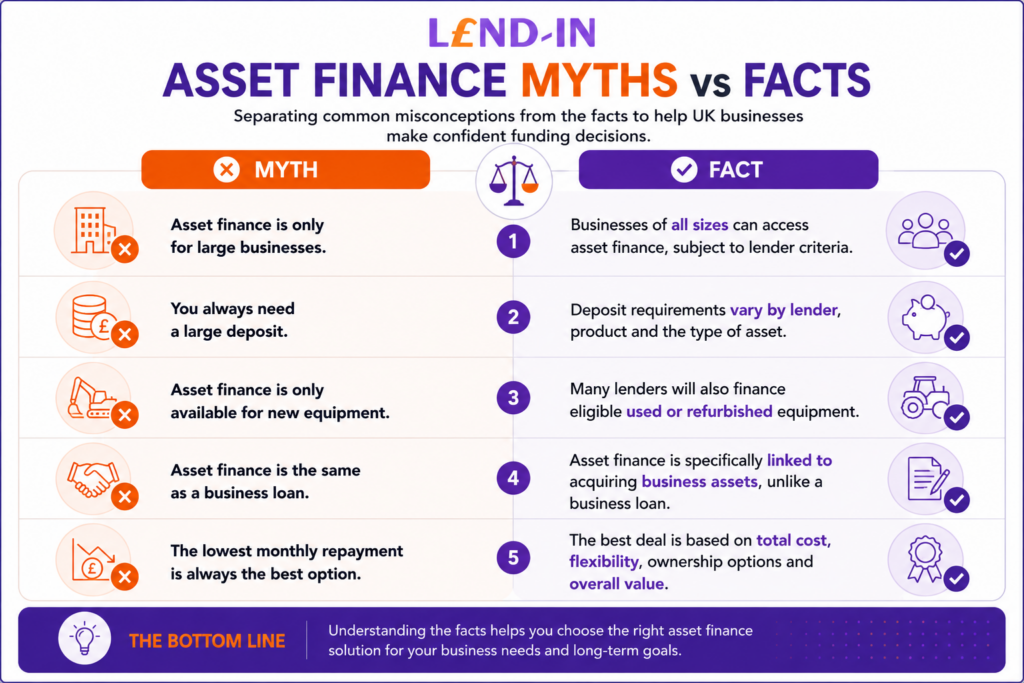
Figure 6. Asset Finance Myths vs Facts
This illustration compares some of the most common misconceptions about asset finance with the facts. Understanding how asset finance works can help UK businesses compare funding options more confidently and choose solutions that align with their operational requirements and long-term business objectives.
Myth 1: Asset Finance Is Only for Large Businesses
Fact: Asset finance is used by businesses of all sizes, from sole traders and start-ups to established SMEs and large corporations. Eligibility depends on factors such as affordability, trading history and the lender’s individual criteria rather than the size of the business alone.
Myth 2: You Always Need a Large Deposit
Fact: Deposit requirements vary depending on the finance provider, the type of asset being purchased and the funding agreement. Some lenders may require a deposit, while others may offer solutions with little or no upfront contribution, subject to their lending criteria.
Myth 3: Asset Finance Is Only Available for New Equipment
Fact: Many lenders will also finance eligible used or refurbished equipment, provided it meets their lending requirements and retains sufficient value throughout the agreement.
Myth 4: Asset Finance Is the Same as a Business Loan
Fact: Although both are forms of business funding, they serve different purposes. Asset finance is specifically linked to purchasing or using business assets, whereas a business loan generally provides funding that can be used for a broader range of business requirements.
Myth 5: The Lowest Monthly Repayment Is Always the Best Option
Fact: Lower monthly repayments may result in a longer agreement or higher overall borrowing costs. Businesses should compare the total cost of finance, contract flexibility, ownership options and repayment structure before making a decision.
Table 4. Asset Finance Myths vs Facts
| Common Myth | The Reality |
|---|---|
| Asset finance is only for large businesses. | Businesses of many sizes use asset finance, subject to lender criteria. |
| A large deposit is always required. | Deposit requirements vary between lenders and products. |
| Only new equipment can be financed. | Many lenders also finance eligible used equipment. |
| Asset finance and business loans are identical. | Asset finance is specifically linked to acquiring business assets. |
| Lowest repayments always represent the best deal. | Businesses should compare the total value of the agreement, not just monthly costs. |
Table 4. Common misconceptions about asset finance and the facts businesses should understand before applying.
💼 Real-World Example
A transport company assumes it cannot finance a three-year-old HGV because it is not brand new. After comparing several lenders, the business discovers that multiple providers are willing to finance eligible used commercial vehicles. As a result, the company acquires the vehicle while preserving working capital for future expansion.
📊 Industry Insight
Asset finance products are designed to meet a wide variety of business requirements. Because lenders have different product ranges, underwriting criteria and asset preferences, comparing multiple providers often reveals funding solutions that businesses may not have considered initially.
⭐ Expert Tip
Never assume one lender’s decision reflects the wider market. If one finance provider is unable to offer a suitable solution, another lender with different eligibility criteria or sector expertise may still be able to help.
✅ Key Takeaway
Understanding the facts behind common asset finance misconceptions enables businesses to compare funding with greater confidence. By focusing on suitability rather than assumptions, organisations can identify finance solutions that better support long-term investment and sustainable growth.
Is Asset Finance Right for Your Business?
Every business has different funding requirements, operational priorities and long-term growth plans. While asset finance can be an effective solution for many organisations, the most appropriate funding option depends on how the asset will be used, your business’s financial position and your broader commercial objectives.
Businesses often choose asset finance because it enables them to invest in essential equipment without making a significant upfront payment. By spreading the cost over manageable monthly repayments, organisations can preserve working capital while continuing to invest in recruitment, inventory, marketing and future growth opportunities.
However, asset finance is not always the most suitable solution. Businesses should carefully consider whether ownership of the asset is important, how long the equipment is expected to remain in use and whether alternative funding products may better support their objectives.
Taking the time to evaluate these factors before applying can help businesses compare funding options more effectively and choose a finance solution that supports sustainable long-term growth.
Asset Finance May Be Suitable If Your Business…
Asset finance could be worth considering if your business:
- Needs machinery, vehicles or equipment to support operations.
- Wants to preserve working capital for day-to-day trading.
- Prefers predictable monthly repayments.
- Is investing in business growth or increasing production capacity.
- Wants to avoid tying up significant cash in depreciating assets.
- Plans to generate revenue from the equipment being financed.
- Requires access to modern equipment to remain competitive.
Alternative Funding Solutions to Consider
Although asset finance is appropriate for many business investments, alternative funding solutions may be more suitable depending on your objectives.
For example:
| Funding Requirement | Potential Funding Solution |
|---|---|
| Purchasing equipment | Asset Finance |
| Improving cash flow | Working Capital Finance |
| General business investment | Business Loan |
| Releasing cash from unpaid invoices | Invoice Finance |
| Purchasing commercial property | Commercial Mortgage |
| Flexible access to ongoing funding | Revolving Credit Facility |
Choosing the right funding solution begins with understanding the purpose of the finance rather than selecting a product first.
Figure 7. Which Business Funding Solution Matches Your Objective?
This illustration demonstrates how different business funding solutions are designed to support different commercial objectives. By identifying the purpose of the funding before approaching lenders, businesses can compare the most appropriate finance products and make more informed financial decisions.
Need Business Funding
          │
          ▼
What is your objective?
          │
 ┌────────┼────────┬────────┬──────────┐
 ▼        ▼        ▼        ▼          ▼
Equipment Cash Flow Property Growth Ongoing Funding
 ▼        ▼        ▼        ▼          ▼
Asset   Working  Commercial Business Revolving
Finance Capital  Mortgage  Loan      Credit
💼 Real-World Example
A logistics company needs five new delivery vehicles following the award of a national distribution contract. Rather than purchasing the vehicles outright, the business uses asset finance to spread the cost over several years, preserving cash flow for recruitment, fuel costs and day-to-day operations while expanding its fleet.
📊 Industry Insight
Businesses that clearly identify why they require funding before comparing products are often better positioned to select finance that supports both immediate operational needs and long-term commercial objectives.
⭐ Expert Tip
Start with your business objective rather than the finance product. Understanding whether your priority is equipment, cash flow, property or business growth makes it much easier to compare lenders and identify the most appropriate funding solution.
✅ Key Takeaway
Asset finance is most effective when it aligns with a clear commercial objective. By understanding how different funding products support different business needs, organisations can make more informed financial decisions while protecting cash flow and supporting sustainable growth.
How Lend-In Helps Businesses Compare Asset Finance
Choosing the right asset finance solution can be challenging, particularly when lenders have different eligibility criteria, repayment structures and underwriting requirements. While one finance provider may specialise in funding commercial vehicles, another may have greater expertise in manufacturing equipment, agricultural machinery or specialist assets.
Rather than approaching lenders individually, businesses can simplify the process by comparing multiple funding solutions through a single application.
At Lend-In, we compare funding options from more than 120 UK lenders, helping businesses identify asset finance solutions that align with their operational requirements, financial position and long-term objectives. Whether you’re funding construction equipment, commercial vehicles, manufacturing machinery, medical technology or office equipment, our aim is to help you compare suitable funding options with confidence.
Because every lender assesses applications differently, comparing the market can provide businesses with access to a broader range of funding solutions than approaching a single finance provider.
Throughout the process, our commercial finance specialists provide guidance to help businesses understand the available options, compare lenders and make informed funding decisions based on their individual circumstances.
Types of Assets We Can Help Finance
Businesses use asset finance to acquire a wide range of equipment across many sectors, including:
- Commercial vehicles and company fleets
- Construction and plant machinery
- Manufacturing and engineering equipment
- Agricultural machinery
- Medical and dental equipment
- Renewable energy systems
- Catering and hospitality equipment
- IT hardware and business technology
- Warehousing and logistics equipment
- Printing and specialist industrial equipment
Every application is assessed individually, and funding availability will depend on the lender’s criteria, the asset being financed and the overall financial profile of the business.
Why Businesses Choose Lend-In
Businesses choose Lend-In because we aim to make comparing business finance straightforward, transparent and informed.
Our approach includes:
- Comparing funding options from 120+ UK lenders.
- Access to a wide range of asset finance products.
- Guidance from experienced commercial finance specialists.
- A straightforward application process.
- Funding solutions tailored to individual business objectives.
- Support throughout the comparison process.
By comparing multiple lenders rather than relying on a single provider, businesses are better positioned to identify funding solutions that support both immediate operational needs and long-term commercial growth.
Figure 8. The Lend-In Asset Finance Comparison Journey
This illustration demonstrates how Lend-In simplifies the asset finance comparison process. By understanding your funding requirements, comparing options from more than 120 UK lenders and presenting suitable funding solutions, businesses can make informed financial decisions with greater confidence.
Business Needs Equipment
          │
          ▼
Single Lend-In Application
          │
          ▼
Compare 120+ UK Lenders
          │
          ▼
Review Suitable Asset Finance Solutions
          │
          ▼
Choose Funding That Fits Your Business
💼 Real-World Example
A manufacturing business requires funding for three new CNC machines. Rather than contacting several finance providers individually, the company submits one application through Lend-In. After comparing multiple lenders, the business reviews a range of suitable funding options and selects the solution that best aligns with its cash flow and long-term investment strategy.
📊 Industry Insight
Different lenders often specialise in different industries, asset types and funding structures. Comparing multiple providers increases the likelihood of identifying a finance solution that reflects your business’s individual circumstances rather than relying on a single lending decision.
⭐ Expert Tip
When comparing asset finance, look beyond the interest rate. Consider ownership options, repayment flexibility, agreement length, maintenance responsibilities and the total cost of finance before making your decision.
✅ Key Takeaway
Comparing asset finance providers can help businesses identify funding that aligns with their operational requirements and long-term commercial objectives. Access to multiple lenders provides greater choice, increased flexibility and a more informed basis for selecting the right funding solution.
Frequently Asked Questions
Asset finance is a type of business funding that allows companies to acquire equipment, machinery, vehicles and other business assets without paying the full purchase price upfront. Instead, businesses spread the cost through regular repayments while preserving working capital.
Asset finance enables a lender or finance provider to fund the purchase or use of a business asset. Depending on the agreement, businesses either own the asset at the end of the term or return it to the finance provider after the agreement concludes.
– Commercial vehicles
– Construction machinery
– Manufacturing equipment
– Agricultural machinery
– Medical equipment
– Office furniture
– IT hardware
– Catering equipment
– Printing equipment
– Renewable energy systems
No. Asset finance is available to businesses of many sizes, including sole traders, partnerships, limited companies and established SMEs, subject to each lender’s eligibility criteria.
Asset finance is specifically used to fund business assets such as equipment or vehicles. A business loan provides more general funding that can usually be used for a wider range of business purposes.
Hire Purchase is an asset finance agreement where businesses spread the cost of an asset over fixed repayments. Once all repayments have been completed and any applicable final fee has been paid, ownership usually transfers to the business.
A Finance Lease allows businesses to use an asset while the finance provider retains ownership. The business pays regular rentals throughout the agreement and may have options available when the lease ends.
An Operating Lease enables businesses to use equipment for a defined period before returning it to the finance provider. This option is commonly chosen where assets require regular replacement or upgrades.
Deposit requirements vary between lenders and finance products. Some agreements require an upfront contribution, while others may be available with little or no deposit, depending on the lender’s criteria and the asset being financed.
Deposit requirements vary between lenders and finance products. Some agreements require an upfront contribution, while others may be available with little or no deposit, depending on the lender’s criteria and the asset being financed.
Agreement lengths vary depending on the asset and finance product. Many agreements range from one to seven years, although longer or shorter terms may be available depending on the lender and business requirements.
Lenders commonly request:
– Business bank statements
– Filed annual accounts
– Management accounts (where available)
– Asset quotations
– Director details
– Information about the business and funding purpose
Some lenders consider start-up businesses, although eligibility requirements are often different from those applied to established companies. Factors such as affordability, deposits and director experience may influence lending decisions.
One of the main advantages of asset finance is that it helps businesses preserve cash flow by spreading the cost of expensive assets over manageable repayments rather than requiring a large upfront investment.
The tax treatment of asset finance depends on the finance agreement and the individual circumstances of the business. Businesses should always seek advice from a qualified accountant or tax adviser regarding any available tax reliefs.
Some lenders allow early settlement, although early repayment charges or settlement calculations may apply. Businesses should review the terms of their agreement before making additional repayments.
Asset finance is widely used across sectors including:
– Construction
– Manufacturing
– Engineering
– Agriculture
– Healthcare
– Hospitality
– Logistics
– Retail
– Transport Professional services
Businesses can strengthen an asset finance application by:
– Keeping financial records up to date.
– Demonstrating affordability.
– Clearly explaining the purpose of the asset.
– Providing complete documentation.
– Comparing multiple lenders.
Every lender has different lending criteria, pricing models and sector expertise. Comparing multiple providers increases the likelihood of identifying funding solutions that best align with your business objectives and financial position.
Lend-In compares funding solutions from more than 120 UK lenders, helping businesses explore asset finance options through a single application. Our commercial finance specialists provide guidance throughout the comparison process, helping businesses make informed funding decisions based on their individual requirements.
Conclusion: Understanding Asset Finance for Sustainable Business Growth
Investing in the right equipment, machinery and business assets is often essential for long-term growth. However, making significant capital purchases outright can place unnecessary pressure on cash flow and limit financial flexibility. Asset finance provides an alternative by enabling businesses to spread the cost of acquiring essential assets while preserving working capital for day-to-day operations and future investment.
As this guide has demonstrated, asset finance is not a single funding product but a range of solutions designed to meet different commercial objectives. Whether a business chooses Hire Purchase, Finance Lease or Operating Lease, the most suitable option will depend on factors such as ownership preferences, affordability, asset lifespan and long-term business strategy.
Preparing thoroughly before applying is equally important. Businesses that maintain accurate financial records, clearly define their funding objectives and compare multiple lenders are often better positioned to secure funding that supports both immediate operational requirements and future growth ambitions. Taking the time to understand how lenders assess applications can also improve confidence throughout the funding process while helping businesses identify suitable finance solutions.
At Lend-In, we believe informed businesses make better financial decisions. By comparing asset finance solutions from more than 120 UK lenders, we help businesses explore a wide range of funding options while providing guidance throughout the comparison process. Our objective is to simplify commercial finance by helping businesses understand their options, compare lenders and identify funding solutions that align with their individual circumstances.
Ultimately, the most effective asset finance solution is one that supports your wider business strategy. By understanding the different funding products available, comparing lenders carefully and selecting finance that aligns with your long-term objectives, your business will be better positioned to invest with confidence, strengthen cash flow and achieve sustainable growth.
✅ Final Takeaway
Asset finance is more than a way to fund equipment—it is a strategic business funding solution that enables organisations to invest in productivity, preserve working capital and support sustainable long-term growth. Choosing the right product and comparing multiple lenders can help businesses make more informed financial decisions while building a stronger foundation for future success.
Continue Your Learning
If you found this guide helpful, explore our other expert resources designed to help UK businesses make informed funding decisions.
The Lend-In Commercial Finance Knowledge Centre provides practical guidance on business funding, cash flow management and commercial lending, helping business owners compare finance solutions with confidence.
Business Funding
Business Finance Explained: The Complete Guide for UK SMEs
Learn how business finance works, compare funding solutions and discover how UK businesses can identify funding that supports sustainable growth.
Best for: Business owners exploring funding for the first time.
Business Loans Explained: The Complete Guide for UK Businesses
Understand how business loans work, compare secured and unsecured borrowing and learn practical ways to improve your chances of approval.
Best for: Businesses seeking structured borrowing to support investment and expansion.
Commercial Finance Explained: The Complete Guide for UK Businesses
Discover how commercial finance works, compare funding products and understand how businesses choose finance solutions that align with their commercial objectives.
Best for: Businesses comparing different commercial finance products.
Cash Flow & Working Capital
Working Capital Explained: The Complete Guide for UK Businesses
Learn how working capital supports healthy cash flow, strengthens liquidity and enables sustainable business growth.
Best for: Businesses looking to improve day-to-day cash flow management.
Invoice Finance Explained (Coming Soon)
Discover how invoice finance helps businesses release cash tied up in unpaid invoices while improving liquidity.
Business Cash Flow Explained (Coming Soon)
Explore practical strategies for improving cash flow, forecasting future income and strengthening financial resilience.
Asset & Equipment Finance
Equipment Finance Explained (Coming Soon)
Learn how equipment finance enables businesses to invest in essential machinery and technology while protecting working capital.
Commercial Mortgages Explained (Coming Soon)
Understand how commercial mortgages help businesses purchase, refinance and invest in commercial property.
Business Growth
Business Credit Score Explained (Coming Soon)
Learn how business credit profiles influence commercial finance applications and lender decisions.
How to Improve Business Loan Approval (Coming Soon)
Discover practical steps businesses can take to strengthen funding applications and improve approval prospects.
Why Business Finance Applications Are Declined (Coming Soon)
Understand the most common reasons business funding applications are declined and learn practical ways to improve future applications.
📚 Explore the Lend-In Commercial Finance Knowledge Centre
Every guide within the Lend-In Commercial Finance Knowledge Centre is written to help UK businesses better understand commercial finance, compare funding solutions and make informed financial decisions. Whether you’re looking to purchase equipment, improve cash flow or invest in long-term business growth, our educational resources are designed to support you at every stage of your funding journey.
References
The following organisations provide authoritative guidance and research on UK business finance, commercial lending and financial management.
Lend-In Commercial Finance Knowledge Centre. Educational Guides on Business Funding and Commercial Finance. Available at: https://lend-in.io
British Business Bank. Small Business Finance Markets Report. Available at: https://www.british-business-bank.co.uk
UK Finance. Business Finance and Lending Statistics. Available at: https://www.ukfinance.org.uk
Financial Conduct Authority (FCA). Business Lending Guidance. Available at: https://www.fca.org.uk
Bank of England. Money and Credit Statistics. Available at: https://www.bankofengland.co.uk
HM Revenue & Customs (HMRC). Business Tax Guidance. Available at: https://www.gov.uk/government/organisations/hm-revenue-customs
Companies House. Guidance for UK Limited Companies. Available at: https://www.gov.uk/government/organisations/companies-house
Institute of Chartered Accountants in England and Wales (ICAEW). Business Finance Resources. Available at: https://www.icaew.com
British Chambers of Commerce. Business Growth and Economic Insights. Available at: https://www.britishchambers.org.uk
Office for National Statistics (ONS). UK Business Statistics. Available at: https://www.ons.gov.uk
Department for Business and Trade. Support for UK Businesses. Available at: https://www.gov.uk/government/organisations/department-for-business-and-trade