
Introduction
Business finance plays a vital role in helping UK businesses grow, manage cash flow and invest in future opportunities. Whether you’re purchasing equipment, hiring new employees, expanding into new markets or strengthening day-to-day working capital, choosing the right funding solution can have a significant impact on your business’s long-term success.
Although many businesses assume the biggest challenge is securing finance, the reality is often different. With more than 120 UK lenders offering a wide range of products, repayment structures and lending criteria, identifying the most suitable business finance solution can be just as important as obtaining funding itself. Selecting the right facility can improve financial flexibility, support sustainable growth and help businesses respond confidently to changing market conditions.
In recent years, access to business finance has remained a key consideration for growing SMEs. The British Business Bank continues to highlight that many businesses face challenges when accessing the right type of funding, while directors often approach only their existing bank despite the wider range of options available across the market. As a result, businesses may overlook funding solutions that are better suited to their objectives.
Every lender assesses applications differently. Factors such as industry sector, affordability, trading history, repayment preferences and overall financial performance all influence lending decisions. Consequently, two businesses with very similar financial profiles may receive completely different outcomes depending on which lenders they approach.
This guide explains how business finance works, explores the most common funding solutions available to UK businesses and highlights the factors business owners should consider before making a funding decision. By understanding the market and comparing the options available, businesses can make more informed financial decisions that support both short-term stability and long-term growth.The UK Business Finance Landscape
Access to business finance continues to play an important role in supporting the growth of UK businesses. However, securing funding is no longer simply about finding a lender. Today’s commercial finance market offers a wide range of funding solutions, each with different eligibility criteria, repayment structures and lending requirements.
According to the British Business Bank, many SMEs continue to face challenges when identifying funding that aligns with their business objectives. While many directors begin by approaching their existing bank, this may only represent a small proportion of the wider lending market. Consequently, businesses that compare multiple lenders are often better positioned to identify funding solutions that meet their operational and financial requirements.
Every lender evaluates applications differently. Factors such as industry sector, affordability, trading history, existing borrowing, repayment preferences and overall financial performance all influence lending decisions. As a result, two businesses with similar financial profiles may receive different outcomes depending on which lenders they approach.
For this reason, comparing business finance options has become an increasingly important part of the funding process. Understanding how lenders assess applications can help businesses make informed decisions, improve their chances of approval and identify funding solutions that support both immediate requirements and long-term growth.
Key Takeaways
By reading this guide, you’ll learn:
- What business finance is and why it plays an important role in supporting UK businesses.
- How different business finance solutions can improve cash flow, support growth and strengthen financial flexibility.
- The factors lenders consider when assessing business finance applications.
- Why comparing multiple lenders can help businesses identify more suitable funding solutions.
- How to choose the right commercial finance product based on your business objectives.
- How Lend-In compares funding from 120+ UK lenders to help businesses explore competitive finance solutions.
Whether you’re looking to improve cash flow, purchase equipment, refinance existing borrowing or invest in future growth, understanding your funding options is the first step towards making informed financial decisions.
Contents
| Section | Purpose / Description |
|---|---|
| Introduction | Provides an overview of business finance in the UK, explains the purpose of the guide, and outlines what readers can expect to learn. |
| The UK Business Finance Landscape | Explores the current business finance market, common funding sources, industry trends, and challenges faced by UK businesses. |
| How Business Finance Works in Practice | Explains how business finance operates, including eligibility, application processes, repayments, and different financing methods. |
| Why the Right Business Finance Solution Matters | Discusses the importance of selecting suitable funding to support business growth, cash flow, and long-term financial stability. |
| How to Choose the Right Business Finance Solution | Provides guidance on evaluating funding options based on business needs, costs, repayment terms, and eligibility criteria. |
| How Lend-In Supports UK Businesses | Highlights how Lend-In helps businesses access tailored finance solutions through a streamlined comparison and application process. |
| Why Compare Business Finance with Lend-In? | Explains the benefits of using Lend-In, including access to multiple lenders, competitive options, and a simplified comparison process. |
| Frequently Asked Questions | Answers common questions about business finance, eligibility, applications, costs, repayments, and the Lend-In process. |
| Conclusion | Summarises the key points and encourages businesses to choose the right finance solution for their needs. |
| References | Lists the sources, reports, and official guidance used to support the information presented in the guide. |
What Is Business Finance?
Business finance refers to the funding businesses use to support their day-to-day operations, invest in growth and manage cash flow. Rather than relying solely on existing cash reserves, businesses can access a variety of finance solutions to purchase equipment, recruit employees, acquire inventory or fund larger customer contracts.
There is no single type of business finance suitable for every organisation. Depending on the purpose of the funding, businesses may choose from products such as business loans, asset finance, invoice finance, working capital finance, commercial mortgages or revolving credit facilities. Consequently, selecting the right solution requires careful consideration of both immediate financial needs and long-term business objectives.
For many UK SMEs, business finance provides the flexibility to seize new opportunities while maintaining healthy cash flow. Understanding the different funding options available allows business owners to make informed decisions that support sustainable growth and strengthen financial resilience.
The UK Business Finance Landscape
The UK business finance market has evolved significantly over the past decade, giving businesses access to a broader range of funding solutions than ever before. While traditional high street banks continue to play an important role, many businesses now choose to compare specialist lenders, alternative finance providers and commercial finance brokers to identify funding that better aligns with their operational requirements and long-term objectives.
For many SMEs, navigating the business finance market can feel overwhelming. Every lender has its own lending appetite, affordability criteria and risk assessment process, meaning the same application may receive different outcomes depending on where it is submitted. Consequently, understanding how the market operates is just as important as understanding the funding products themselves.
According to the British Business Bank, access to finance remains a key consideration for many growing UK businesses. Although funding is widely available across the market, identifying the most appropriate solution often requires businesses to compare multiple lenders rather than relying solely on their existing banking provider. As a result, businesses that explore a wider range of finance options may discover facilities that offer greater flexibility, more suitable repayment structures or funding tailored to their sector.
Several factors influence how lenders assess business finance applications, including:
- Industry sector and trading activity
- Business turnover and profitability
- Trading history and financial performance
- Existing borrowing commitments
- Affordability and repayment capacity
- Director and business credit profiles
- Purpose of the funding
- Security requirements, where applicable
These factors mean that two businesses with similar turnover may receive different funding offers depending on the lender’s criteria, sector appetite and overall risk assessment. Therefore, comparing multiple funding providers can increase the likelihood of identifying a business finance solution that supports both immediate funding requirements and long-term business growth.
As the commercial finance market continues to expand, businesses have more choice than ever before. From business loans and working capital finance to asset finance, invoice finance, commercial mortgages and revolving credit facilities, selecting the right funding product depends on how the finance will be used and the level of flexibility required. Understanding the wider business finance landscape enables directors to make informed decisions that strengthen cash flow, improve financial resilience and support sustainable growth.
Key Insight
The UK business finance market is no longer limited to traditional bank lending. Comparing multiple lenders and funding products allows businesses to identify finance solutions that align with their objectives, improve cash flow and provide the flexibility needed to support future growth.
How Business Finance Works in Practice
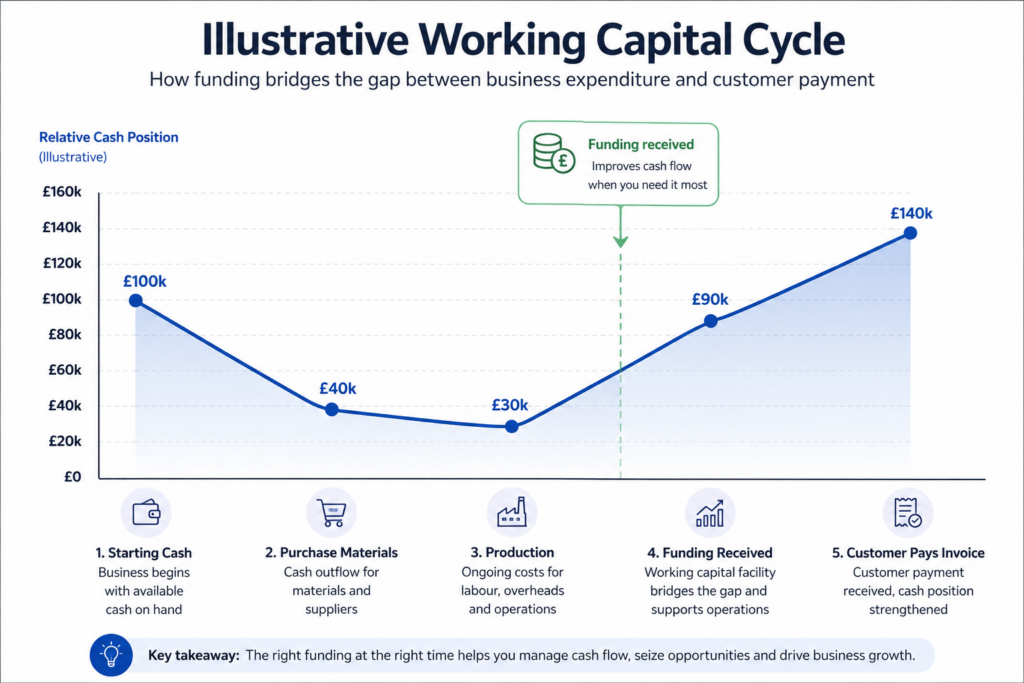
Understanding the value of business finance becomes much easier when viewed through a real-world example. Many successful businesses require funding not because they are struggling financially, but because they need to bridge the gap between incurring costs and receiving customer payments.
Imagine a manufacturing business secures a new contract worth £500,000. The opportunity represents significant growth, but fulfilling the order requires substantial investment before any revenue is received. Raw materials must be purchased, production capacity increased and additional staffing costs covered to deliver the project on schedule.
Although the customer has committed to purchasing the finished goods, payment will not be received until 60 days after delivery. Consequently, the business faces a temporary cash flow gap despite the contract being profitable.
Rather than delaying production or placing unnecessary pressure on existing cash reserves, the business uses working capital finance to fund its short-term operating costs. This allows materials to be purchased immediately, employees to be paid on time and production to continue without interruption. Once the customer settles the invoice, the facility is repaid, leaving the business with stronger cash flow, completed work and increased revenue.
This example demonstrates why business finance should not simply be viewed as borrowing money. When used strategically, it enables businesses to maintain liquidity, manage working capital effectively and pursue growth opportunities that may otherwise be difficult to achieve using existing cash reserves alone.
Table 1. Key Factors UK Lenders Consider When Assessing Business Finance Applications
| Assessment Area | Why It Matters |
|---|---|
| Business turnover | Indicates trading performance and repayment capacity. |
| Profitability | Demonstrates the ability to service finance repayments. |
| Trading history | Helps lenders assess business stability and experience. |
| Existing borrowing | Influences affordability and overall risk. |
| Industry sector | Some lenders specialise in specific industries. |
| Purpose of funding | Ensures the finance product matches the business requirement. |
Figure 1- Illustrative Working Capital Cycle for UK Businesses
This illustration demonstrates how working capital supports UK businesses by bridging the gap between upfront operating costs and customer payments. By maintaining healthy cash flow and improving liquidity, businesses can continue trading confidently, meet short-term financial commitments and invest in sustainable long-term growth.
What This Means for Your Business
If your business regularly incurs costs before receiving customer payments, choosing the right business finance solution can help improve cash flow, maintain day-to-day operations and support future growth. Comparing funding options from multiple lenders increases the likelihood of finding a facility that matches your business’s objectives and repayment preferences.
Understanding the Business Finance Funding Cycle
Figure 1 illustrates how business finance can help businesses bridge the gap between upfront operating costs and customer payments. In many industries, businesses need to purchase stock, pay suppliers or recruit additional staff before receiving payment for completed work. Consequently, maintaining access to suitable funding can help businesses continue operating efficiently without placing unnecessary pressure on cash flow.
Rather than replacing revenue, business finance provides businesses with the flexibility to manage temporary funding gaps while continuing to invest in growth opportunities. Whether funding is used to purchase equipment, fulfil larger customer orders or support seasonal demand, selecting the right finance solution can improve liquidity, strengthen financial resilience and support long-term business growth.
Understanding how the funding cycle works enables business owners to make more informed financial decisions. By comparing business finance options and choosing facilities that align with their operational requirements, businesses can improve cash flow management while creating a stronger foundation for future growth.
Key Insight
Successful businesses often use business finance strategically rather than reactively. Access to the right funding solution can help improve cash flow, support business growth and provide the flexibility needed to seize new opportunities with confidence.
Why the Right Business Finance Solution Matters
Choosing the right business finance solution is about far more than simply accessing funding. The most suitable facility should strengthen cash flow, support day-to-day operations and provide the flexibility your business needs to grow with confidence.
Every business has different financial requirements. Consequently, the most appropriate funding solution will depend on factors such as your industry, trading cycle, growth plans and repayment preferences. While interest rates remain an important consideration, they should never be the only factor when comparing commercial finance options.
Many businesses use business finance to:
- Improve cash flow and working capital
- Purchase machinery, vehicles or equipment
- Buy inventory before peak trading periods
- Recruit additional employees
- Complete larger customer contracts
- Manage seasonal fluctuations in demand
- Refinance existing borrowing
- Invest in business growth and expansion
Selecting the right repayment structure can often deliver greater long-term value than simply choosing the lowest headline interest rate. Features such as flexible drawdown facilities, longer repayment terms and products with no early settlement charges can improve financial flexibility while supporting sustainable business growth.
How to Choose the Right Business Finance Solution
Comparing business finance options before making a decision can help businesses identify funding that aligns with both their immediate requirements and long-term objectives. Since every lender has different lending criteria and product features, reviewing multiple options often provides greater flexibility than approaching a single provider.
Before accepting a funding offer, consider asking the following questions:
- Have I compared multiple lenders?
- Does this funding solution support my business objectives?
- Are there any early settlement fees or hidden charges?
- Can the facility grow alongside my business?
- Will repayments remain affordable throughout the agreement?
- Am I paying interest only on the funds I use?
- Is there a more flexible funding option available?
Taking the time to compare these factors can help businesses make more informed financial decisions while avoiding unnecessary costs. Ultimately, the best commercial finance solution is not always the one with the lowest interest rate. Instead, it should provide the flexibility, affordability and support needed to achieve sustainable business growth.
How Lend-In Supports UK Businesses
Finding the right business finance solution can be time-consuming, particularly when lenders have different eligibility criteria, pricing structures and repayment options. Rather than approaching lenders individually, businesses can simplify the process by comparing multiple funding options through a single application.
At Lend-In, we compare funding solutions from more than 120 UK lenders, helping businesses identify suitable business finance and commercial finance options tailored to their objectives. Whether you’re looking to improve working capital, purchase equipment, refinance existing borrowing or fund future growth, our team compares the market to help you make an informed decision.
We can help businesses explore a wide range of funding solutions, including:
- Business Loans
- Commercial Finance
- Working Capital Finance
- Revolving Credit Facilities
- Asset Finance
- Equipment Finance
- Invoice Finance
- Growth Finance
- Commercial Mortgages
Throughout the process, you’ll receive guidance from a dedicated commercial finance specialist who will help you understand your options and compare funding solutions based on your business’s individual requirements. Our objective is to make the funding process straightforward, transparent and focused on helping your business achieve its long-term goals.
Why Compare Business Finance with Lend-In?
Choosing the right funding partner is just as important as choosing the right funding product. At Lend-In, we combine access to 120+ UK lenders with expert guidance to help businesses compare funding solutions confidently.
By reviewing multiple lenders through one application, businesses can save valuable time while exploring competitive business finance, commercial finance and working capital finance options designed to support growth, improve cash flow and strengthen long-term financial resilience.
Conclusion: Choosing the Right Business Finance for Long-Term Success
Selecting the right business finance solution is about more than securing funding. Whether you’re looking to improve cash flow, purchase equipment, expand your operations or invest in future growth, choosing a facility that aligns with your business objectives can strengthen financial resilience and support long-term success.
As we’ve explored throughout this guide, the UK business finance market offers a wide range of funding solutions, each designed to meet different business needs. Understanding how lenders assess applications, comparing multiple funding options and selecting the right repayment structure can help businesses make more informed financial decisions while avoiding unnecessary costs.
Rather than approaching a single lender, comparing the wider market allows businesses to explore finance solutions that offer greater flexibility, competitive pricing and funding tailored to their circumstances. Taking the time to understand your options today can help create stronger financial foundations for tomorrow.
If you’re considering business finance, commercial finance or working capital finance, Lend-In compares funding solutions from more than 120 UK lenders through a single application. Our team works closely with businesses across a wide range of industries to help identify funding options that support growth, improve cash flow and provide the flexibility needed to achieve long-term business goals.
References
This article has been prepared using publicly available information and industry guidance from the following organisations:
1. British Business Bank – Small Business Finance Markets Report and guidance on SME finance and lending.
https://www.british-business-bank.co.uk
2. Bank of England – Monetary Policy Reports and information relating to business lending and credit conditions.
https://www.bankofengland.co.uk
3. UK Finance – Industry statistics and publications covering commercial lending and SME finance.
https://www.ukfinance.org.uk
4. Financial Conduct Authority (FCA) – Guidance on regulated lending, consumer protections and financial services.
https://www.fca.org.uk
5. Office for National Statistics (ONS) – UK business demographics, economic performance and SME statistics.
https://www.ons.gov.uk
6. Department for Business and Trade – Information relating to UK businesses, growth and investment.
https://www.gov.uk/government/organisations/department-for-business-and-trade
Frequently Asked Questions
A business loan provides access to funds that are repaid over an agreed period, usually through fixed monthly repayments. Depending on the lender and product, interest may be charged on the full loan amount or only on the funds utilised.
Business finance is a broad term covering all forms of funding available to businesses. Commercial finance generally refers to funding products designed specifically for trading businesses, including commercial mortgages, asset finance, invoice finance and working capital facilities.
Business finance is funding used by companies to support growth, improve cash flow, purchase equipment, hire staff or invest in new opportunities. Common types of business finance include business loans, commercial finance, asset finance, invoice finance and revolving credit facilities.
Comparing business loans involves reviewing interest rates, repayment structures, eligibility criteria, fees, flexibility and early settlement terms. Working with a commercial finance broker like Lend-In can provide access to multiple lenders through a single application
Many brokers and lenders offer an initial eligibility assessment that does not impact your credit score. If you decide to proceed with a specific lender, they may carry out a credit search as part of their underwriting process.
Businesses can choose from a range of funding solutions, including:
– Business loans
– Revolving credit facilities
– Working capital finance
– Asset finance
– Invoice finance
– Merchant cash advance
– Commercial mortgages
– Development finance
The most suitable option depends on your business objectives and financial circumstances.
Business finance can support a wide range of objectives, including:
– Improving cash flow
– Purchasing equipment or machinery
– Buying stock and inventory
– Hiring employees
– Business expansion
– Marketing investment
– Refinancing existing borrowing
– Funding seasonal demand
The amount available depends on factors such as turnover, profitability, affordability, industry, trading history and the lender’s criteria. Every lender assesses applications differently, so available funding can vary.
A commercial finance broker compares multiple lenders on your behalf, helping you identify funding solutions that best match your business needs. This can save time and provide access to lenders you may not have approached independently.
Every lender has different pricing, risk appetite and lending criteria. Comparing multiple lenders can improve the likelihood of finding a funding solution that offers the right balance of flexibility, affordability and suitability.