✅ Key Takeaways
- A commercial mortgage enables businesses to purchase, refinance or invest in commercial property over an agreed repayment period.
- Commercial mortgages can be used for owner-occupied premises, investment properties and certain semi-commercial properties, subject to lender criteria.
- Lenders commonly assess affordability, business performance, property value, deposit size and repayment capacity before approving an application.
- Comparing multiple commercial mortgage providers can help businesses identify funding that aligns with their objectives and financial circumstances.
- Understanding how commercial mortgages work before applying can improve decision-making and strengthen the quality of your application.
Introduction
For many UK businesses, purchasing commercial property represents one of the most significant long-term investments they will ever make. Whether acquiring office premises, expanding into larger industrial units, purchasing retail space or investing in commercial property as part of a wider growth strategy, securing the right funding is often a critical step in achieving those ambitions.
A commercial mortgage provides businesses with the opportunity to finance commercial property over an agreed period rather than paying the full purchase price upfront. By spreading repayments over a longer term, businesses can preserve working capital, improve financial flexibility and invest in premises that support future growth.
Commercial mortgages are used across a wide range of industries and business types. Some organisations purchase premises from which they operate, while others invest in commercial property to generate rental income or build long-term assets. Although the funding objective may differ, the underlying principles remain similar: lenders assess both the business and the property before determining whether the mortgage is suitable.
However, commercial mortgages are not a single product. Different lenders offer varying repayment structures, deposit requirements, interest rate options and eligibility criteria. Understanding these differences is essential when comparing providers and selecting funding that aligns with your commercial objectives.
This guide explains how commercial mortgages work, explores the different types of commercial mortgage available to UK businesses and highlights the key factors lenders commonly assess during the application process. It also provides practical guidance on improving your chances of approval and comparing funding options with confidence, helping businesses make informed property finance decisions that support sustainable long-term growth.
Contents
| Section | Topic |
|---|---|
| 1 | Introduction |
| 2 | Key Takeaways |
| 3 | What Is a Commercial Mortgage? |
| 4 | Figure 1. Illustrative Commercial Mortgage Journey |
| 5 | How Commercial Mortgages Work |
| 6 | Figure 2. Commercial Mortgage Process |
| 7 | Types of Commercial Mortgages |
| 8 | Figure 3. Commercial Mortgage Comparison |
| 9 | Choosing the Right Commercial Mortgage |
| 10 | Figure 4. Commercial Mortgage Decision Framework |
| 11 | How Lenders Assess Commercial Mortgage Applications |
| 12 | Figure 5. Commercial Mortgage Assessment Dashboard |
| 13 | How to Improve Your Chances of Approval |
| 14 | Figure 6. Building a Strong Commercial Mortgage Application |
| 15 | Common Commercial Mortgage Myths Explained |
| 16 | Figure 7. Commercial Mortgage Myths vs Facts |
| 17 | Is a Commercial Mortgage Right for Your Business? |
| 18 | Figure 8. Commercial Mortgage Decision Checklist |
| 19 | How Lend-In Helps Businesses Compare Commercial Mortgages |
| 20 | Figure 9. The Lend-In Commercial Mortgage Comparison Journey |
| 21 | Frequently Asked Questions |
| 22 | Conclusion |
| 23 | Continue Your Learning |
| 24 | References |
What Is a Commercial Mortgage?
A commercial mortgage is a type of business finance that enables businesses and commercial property investors to purchase, refinance or release equity from commercial property. Instead of paying the full purchase price upfront, businesses borrow an agreed amount from a lender and repay it over a fixed or variable term, together with any applicable interest.
Commercial mortgages are commonly used to purchase properties such as offices, warehouses, industrial units, retail premises, medical practices, hotels and mixed-use commercial buildings. They may also be used to refinance an existing commercial mortgage, release equity from owned property or support wider business investment, subject to the lender’s criteria.
Unlike a residential mortgage, which is designed for personal homes, a commercial mortgage is intended for properties used for business purposes or held as commercial investments. Because the property itself forms part of the lender’s security, providers assess both the value of the property and the financial strength of the borrower before approving an application.
For many UK businesses, purchasing commercial premises can provide greater long-term stability than leasing. Owning business property may offer greater control over operating costs, reduce reliance on landlords and create a valuable long-term business asset while preserving working capital for day-to-day operations.
Commercial mortgages are used across a wide range of industries and sectors, from manufacturers purchasing factory units and retailers acquiring shop premises to healthcare providers investing in surgeries and commercial investors building diversified property portfolios.
Although commercial mortgages are widely available, products, repayment structures, deposit requirements and eligibility criteria differ between lenders. Understanding these differences before applying helps businesses compare funding options more effectively and choose a solution that aligns with their long-term commercial objectives.
Why Do Businesses Use Commercial Mortgages?
Businesses choose commercial mortgages for many different reasons, including:
- Purchasing owner-occupied business premises.
- Investing in commercial property.
- Refinancing an existing commercial mortgage.
- Releasing equity from owned commercial property.
- Expanding into larger premises.
- Reducing long-term rental costs.
- Building long-term business assets.
- Supporting business growth through property ownership.
The most suitable funding solution depends on the business’s objectives, financial position and the type of property being financed.
💼 Real-World Example
A manufacturing company has rented the same industrial unit for several years. As production increases, the directors decide to purchase the premises rather than continue leasing.
By securing a commercial mortgage, the business spreads the purchase cost over an agreed repayment period while retaining working capital to invest in new machinery, recruit additional staff and expand production capacity.
📊 Industry Insight
Many established businesses choose to purchase their trading premises once they have achieved stable cash flow. Property ownership can provide greater long-term certainty over occupancy costs while allowing the business to build equity in a commercial asset over time.
⭐ Expert Tip
Before comparing commercial mortgages, clearly define your objective. Purchasing your own trading premises, investing in commercial property and refinancing an existing mortgage often require different lending structures and assessment criteria.
✅ Key Takeaway
A commercial mortgage enables businesses to purchase, refinance or invest in commercial property while spreading the cost over an agreed repayment period. Understanding your funding objective before comparing lenders helps identify the most appropriate commercial mortgage solution.
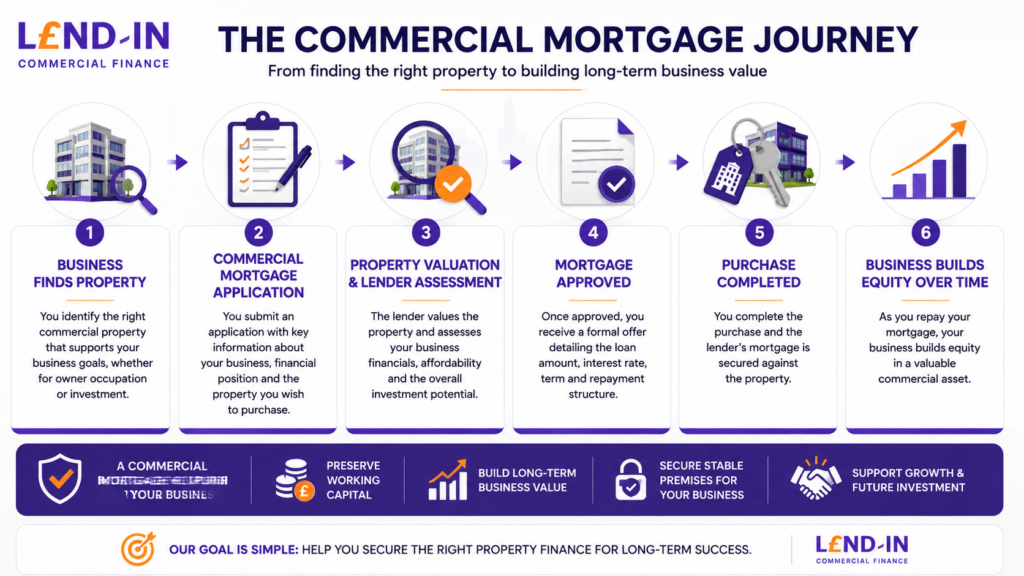
Figure 1. Illustrative Commercial Mortgage Journey
This illustration demonstrates how a commercial mortgage helps UK businesses purchase or refinance commercial property while spreading repayments over an agreed term. By providing long-term property finance, commercial mortgages enable businesses to preserve working capital, build commercial assets and support sustainable growth.
How Commercial Mortgages Work
A commercial mortgage enables businesses to purchase or refinance commercial property by borrowing an agreed amount from a lender and repaying it over a specified term. Instead of paying the full purchase price upfront, the business contributes a deposit while the lender provides the remaining funding, subject to its lending criteria.
Unlike many other forms of business finance, a commercial mortgage is secured against the property being purchased or refinanced. This means the lender takes a legal charge over the property until the mortgage has been repaid in full. Because the property provides security, lenders assess both the value of the property and the financial strength of the applicant before making a lending decision.
Once approved, the mortgage funds are released to complete the property purchase or refinance. The business then makes regular monthly repayments consisting of capital and interest, or in some cases interest only, depending on the terms of the agreement.
As repayments are made, the outstanding mortgage balance gradually reduces while the business builds equity in the property. Over time, this can create a valuable commercial asset that supports long-term financial stability and future investment opportunities.
Commercial mortgages are available with different repayment structures, interest rate options and loan terms. Selecting the most appropriate arrangement depends on the business’s cash flow, investment objectives and long-term property strategy.
Figure 2. How a Commercial Mortgage Works
This illustration demonstrates the typical commercial mortgage process, from identifying a suitable property through to mortgage repayment and equity growth. Understanding each stage helps businesses compare commercial mortgage products with greater confidence while planning long-term property investment.
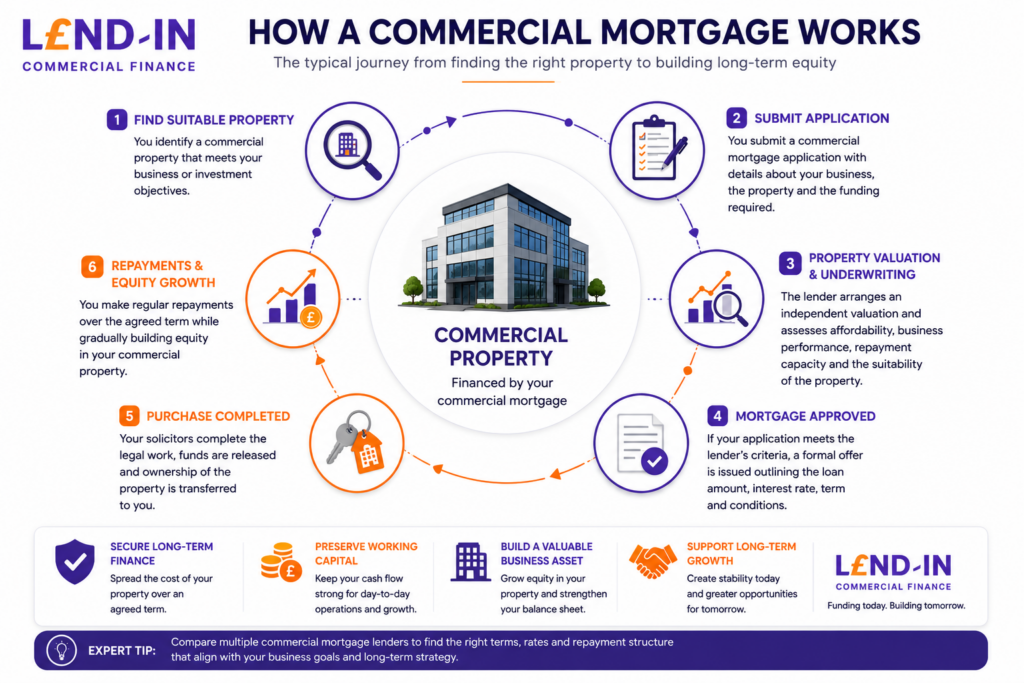
The Typical Commercial Mortgage Process
Most commercial mortgage applications follow a similar journey:
1. Identify a Suitable Property
The business identifies a commercial property that supports its operational or investment objectives.
2. Submit a Commercial Mortgage Application
An application is submitted with information about the business, the property, financial performance and the funding requirement.
3. Property Valuation and Underwriting
The lender arranges an independent valuation and assesses affordability, business performance, repayment capacity and the suitability of the property.
4. Mortgage Offer Issued
If the application meets the lender’s criteria, a formal mortgage offer is issued outlining the loan amount, interest rate, repayment term and any conditions.
5. Legal Completion
Solicitors complete the legal work, funds are released and ownership of the property transfers to the purchaser.
6. Repayments and Equity Growth
The business makes regular repayments over the agreed term while gradually increasing its ownership interest in the property.
💼 Real-World Example
A growing engineering company has outgrown its rented premises and identifies a larger industrial unit that better supports future production. Instead of continuing to lease, the business secures a commercial mortgage, contributes a deposit and spreads the remaining purchase cost over an agreed repayment term. This allows the company to preserve working capital for new machinery and recruitment while building equity in a commercial asset.
📊 Industry Insight
Many businesses view commercial property ownership as a strategic investment rather than simply an operating expense. While leasing offers flexibility, owning commercial premises can provide greater long-term certainty over occupancy costs and create an appreciating business asset, depending on market conditions.
⭐ Expert Tip
Before applying for a commercial mortgage, prepare a realistic budget that includes not only the purchase price but also valuation fees, legal costs, Stamp Duty Land Tax (where applicable), ongoing maintenance and any refurbishment costs. Understanding the full cost of ownership helps businesses plan more effectively.
✅ Key Takeaway
A commercial mortgage enables businesses to purchase or refinance commercial property while spreading repayments over time. Understanding the application process, lender assessment and repayment structure helps businesses compare mortgage options more effectively and make informed long-term property finance decisions.
Types of Commercial Mortgages
Although the term commercial mortgage is often used broadly, several different types of commercial mortgage are available to UK businesses and property investors. The most appropriate option depends on how the property will be used, the business’s long-term objectives and the lender’s eligibility criteria.
Some businesses purchase premises from which they operate, while others acquire commercial property as an investment to generate rental income. Mixed-use properties, containing both residential and commercial elements, may also require specialist mortgage products.
Understanding the different types of commercial mortgage before comparing lenders helps businesses identify funding that aligns with their operational requirements, investment strategy and long-term financial goals.
The three most common commercial mortgage products are Owner-Occupied Commercial Mortgages, Commercial Investment Mortgages and Semi-Commercial Mortgages.
Figure 3. Comparing the Main Types of Commercial Mortgages
This comparison illustrates the three primary types of commercial mortgages available to UK businesses and investors. Understanding how each mortgage differs in purpose, occupancy and investment objective helps businesses select the most appropriate property finance solution.
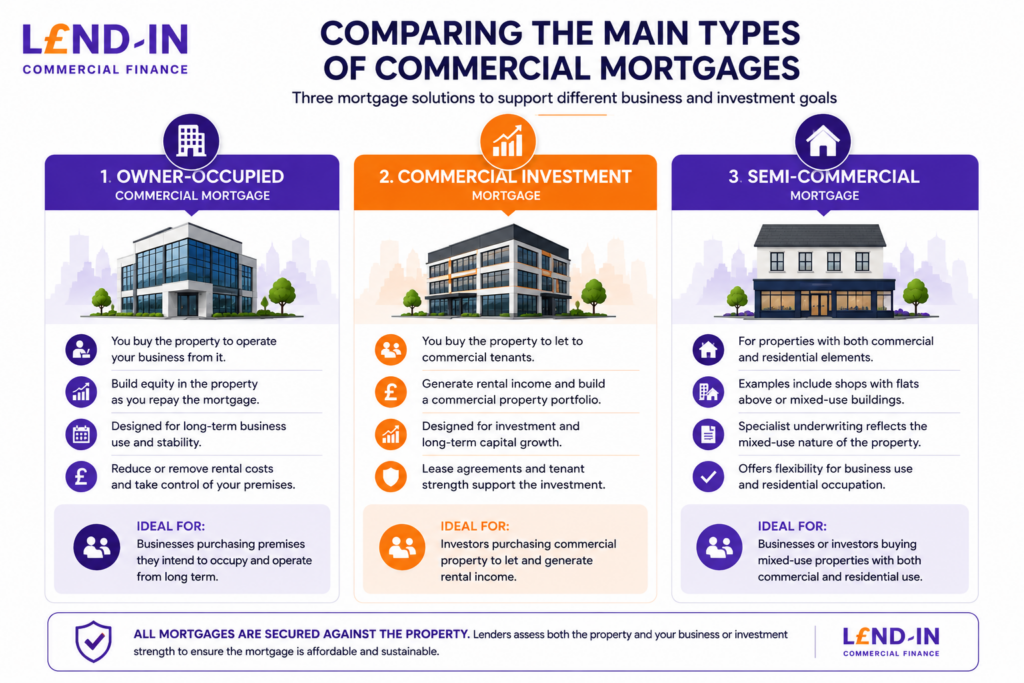
Owner-Occupied Commercial Mortgages
An Owner-Occupied Commercial Mortgage is designed for businesses purchasing premises that they intend to occupy and operate from themselves.
This is one of the most common forms of commercial mortgage and is frequently used to purchase:
- Offices
- Industrial units
- Warehouses
- Retail premises
- Medical practices
- Restaurants
- Hotels
Many businesses choose owner-occupied commercial mortgages to reduce long-term rental costs, gain greater control over their premises and build equity in a valuable commercial asset.
Owner-Occupied Commercial Mortgages may be suitable if your business:
- Operates from commercial premises.
- Plans to remain at the property long term.
- Wants to build equity rather than pay rent.
- Requires greater control over business premises.
- Is investing in future growth.
Commercial Investment Mortgages
A Commercial Investment Mortgage is intended for investors purchasing commercial property that will be leased to tenants rather than occupied by the borrower.
These mortgages are commonly used for:
- Office buildings
- Retail units
- Industrial estates
- Warehouses
- Multi-let commercial premises
Lenders typically assess the property’s investment potential alongside expected rental income and the applicant’s financial position.
Commercial Investment Mortgages may be suitable if you:
- Intend to generate rental income.
- Are expanding a commercial property portfolio.
- Wish to invest in long-term commercial assets.
- Purchase property for investment rather than occupation.
Semi-Commercial Mortgages
A Semi-Commercial Mortgage is designed for properties containing both commercial and residential elements.
Examples include:
- Shops with flats above.
- Public houses with owner accommodation.
- Mixed-use buildings.
- Commercial premises with residential living space.
Because these properties combine residential and commercial use, lenders often apply specialist underwriting criteria when assessing applications.
Semi-Commercial Mortgages may be suitable if:
- The property includes residential accommodation.
- Income is generated from both commercial and residential use.
- The property has mixed-use planning classification.
Table 1. Comparing Commercial Mortgage Types
| Mortgage Type | Typical Purpose | Who Uses It? |
|---|---|---|
| Owner-Occupied Commercial Mortgage | Purchase business premises | Trading businesses |
| Commercial Investment Mortgage | Purchase investment property | Commercial investors |
| Semi-Commercial Mortgage | Purchase mixed-use property | Businesses and investors |
Table 1. Comparison of the three most common commercial mortgage products.
💼 Real-World Example
A dental practice has rented its surgery for several years but wishes to secure permanent premises. By obtaining an Owner-Occupied Commercial Mortgage, the practice purchases the building, gains greater certainty over occupancy costs and gradually builds equity in the property while continuing to provide patient services.
📊 Industry Insight
Commercial mortgage products are designed around the intended use of the property. Lenders often apply different affordability assessments and lending criteria depending on whether the property will be occupied by the business or held as an investment.
⭐ Expert Tip
Before comparing lenders, clearly identify whether the property is owner-occupied, investment or mixed-use. Choosing the correct mortgage category from the outset can help streamline the application process and ensure you are comparing suitable funding options.
✅ Key Takeaway
Owner-Occupied, Commercial Investment and Semi-Commercial Mortgages each serve different business objectives. Understanding how these products differ enables businesses and investors to select commercial property finance that supports their long-term goals.
Choosing the Right Commercial Mortgage
Selecting the right commercial mortgage is about more than simply securing funding for a property purchase. The most suitable mortgage depends on how the property will be used, your business objectives, cash flow position and long-term investment strategy.
Some businesses purchase commercial property to operate from their own premises, while others acquire buildings to generate rental income or diversify an investment portfolio. Mixed-use properties often require specialist mortgage products with different lending criteria.
Before comparing lenders, businesses should first establish why they are purchasing the property. Understanding the purpose of the investment helps identify the most appropriate commercial mortgage product while ensuring the funding structure supports future business growth.
Alongside the intended use of the property, businesses should also consider deposit requirements, affordability, repayment terms, interest rate options and the flexibility offered by different lenders.
Comparing commercial mortgage providers rather than relying on a single lender can provide access to a wider range of products, helping businesses identify funding that aligns with their commercial objectives and financial circumstances.
Figure 4. Choosing the Right Commercial Mortgage
This decision framework helps UK businesses identify the most appropriate commercial mortgage based on how the property will be used. By understanding the purpose of the purchase before comparing lenders, businesses can make informed property finance decisions that support long-term growth.
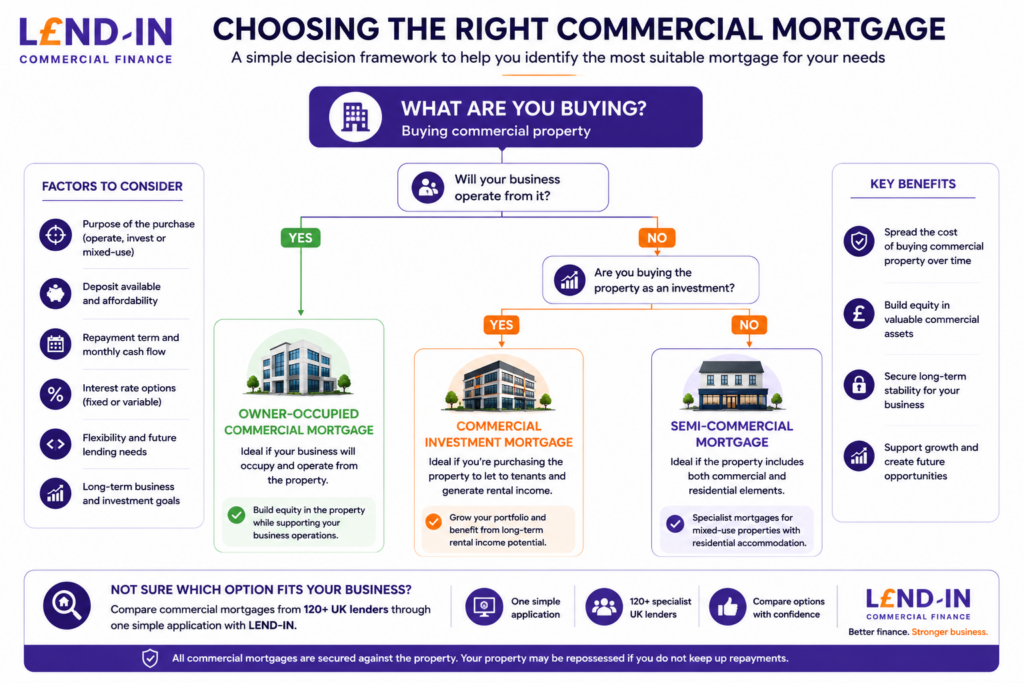
Questions to Ask Before Choosing a Commercial Mortgage
Before applying for a commercial mortgage, consider the following questions:
- Will the property be occupied by your own business?
- Are you purchasing the property as a commercial investment?
- Does the building include both commercial and residential elements?
- How much deposit can your business comfortably contribute?
- Are you seeking fixed or variable interest rates?
- How important is repayment flexibility?
- Does the property support your long-term business strategy?
- Have you compared multiple lenders before making a decision?
Answering these questions before approaching lenders helps narrow down the most appropriate mortgage product while making it easier to compare finance solutions objectively.
💼 Real-World Example
A family-owned wholesale business has rented warehouse space for over a decade. As the business continues to grow, the directors decide to purchase larger premises to support expansion.
Because the warehouse will be occupied by the business rather than rented to tenants, an Owner-Occupied Commercial Mortgage is the most appropriate solution. This allows the business to spread the purchase cost over an agreed term while gradually building equity in a valuable commercial asset.
📊 Industry Insight
Commercial mortgage lenders assess funding differently depending on the intended use of the property. Owner-occupied premises, investment properties and mixed-use buildings each have distinct lending considerations, making it important to identify the correct mortgage category before applying.
⭐ Expert Tip
Don’t begin by comparing interest rates alone. First establish the purpose of the property purchase, your preferred repayment structure and your long-term business objectives. This approach helps ensure you’re comparing mortgage products that genuinely meet your needs.
✅ Key Takeaway
Choosing the right commercial mortgage begins with understanding how the property will be used. By identifying your funding objective first and comparing multiple lenders, you can select a mortgage that supports both your immediate property purchase and your long-term business strategy.
How Lenders Assess Commercial Mortgage Applications
Every commercial mortgage lender has its own underwriting criteria, but most providers assess a combination of the property’s value, the financial strength of the applicant and the overall affordability of the proposed borrowing before making a lending decision.
Unlike many unsecured forms of business finance, a commercial mortgage is secured against the property being purchased or refinanced. As a result, lenders evaluate not only the business’s financial position but also the quality, location and market value of the commercial property.
The purpose of the assessment is to determine whether the mortgage is affordable, whether the property provides suitable security and whether the borrowing aligns with the lender’s appetite for risk.
Commercial mortgage providers typically consider multiple factors rather than relying on a single measure. Strong financial performance, a realistic deposit, sustainable cash flow and a suitable property all contribute towards a stronger application.
Because lending criteria differ between providers, comparing multiple commercial mortgage lenders often increases the likelihood of identifying funding that reflects the business’s individual circumstances and long-term objectives.
What Do Commercial Mortgage Lenders Look For?
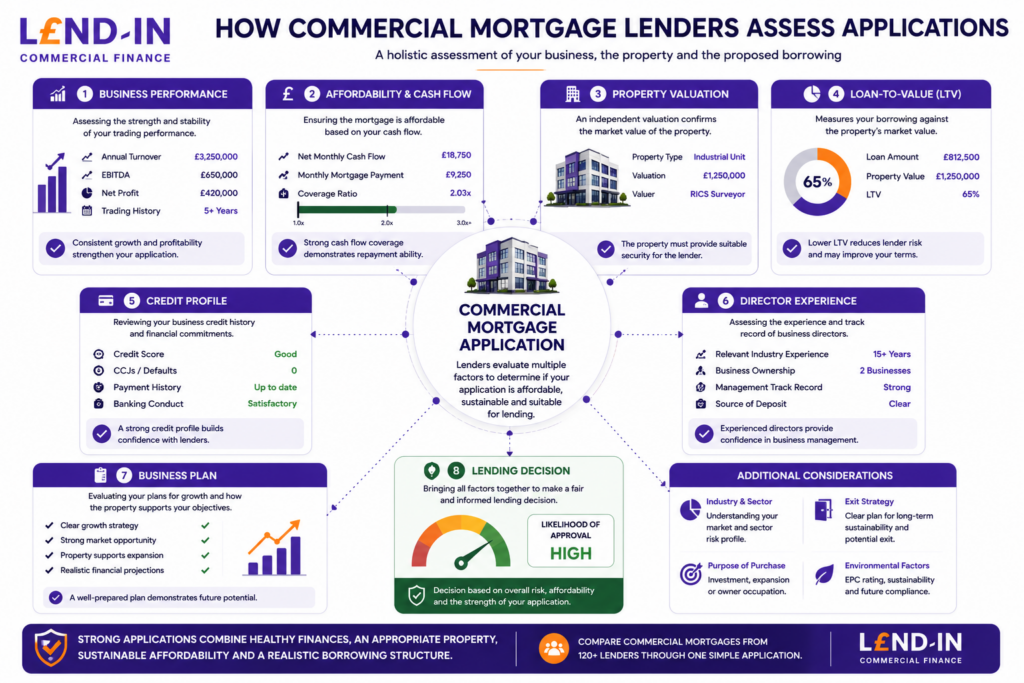
Although every lender uses different criteria, commercial mortgage providers commonly assess the following areas:
- Business turnover and profitability.
- Trading history.
- Affordability and repayment capacity.
- Deposit size.
- Value and condition of the commercial property.
- Loan-to-value (LTV) ratio.
- Business credit profile.
- Existing borrowing commitments.
- Cash flow performance.
- Industry sector and business model.
- Director experience.
- Purpose of the property purchase.
Rather than assessing these factors individually, lenders build an overall picture of the business and the proposed transaction before deciding whether to proceed with a mortgage offer.
Table 2. What Commercial Mortgage Lenders Commonly Assess
| Assessment Area | Why It Matters |
|---|---|
| Business turnover | Demonstrates trading activity and income. |
| Profitability | Indicates the ability to support mortgage repayments. |
| Cash flow | Helps assess affordability throughout the loan term. |
| Deposit | Reduces lending risk and influences loan-to-value. |
| Property valuation | Confirms the market value of the security. |
| Loan-to-value (LTV) | Measures borrowing against the property’s value. |
| Credit profile | Demonstrates previous borrowing performance. |
| Existing liabilities | Assesses current financial commitments. |
| Director experience | Provides confidence in business management. |
| Business plan | Supports future growth and repayment strategy. |
Table 2. Common factors commercial mortgage lenders review when assessing an application.
Figure 5. How Commercial Mortgage Lenders Assess Applications
This illustration demonstrates the typical assessment process followed by commercial mortgage lenders. By reviewing the business, the property and the proposed borrowing together, lenders determine whether the application is affordable and suitable for long-term lending.
💼 Real-World Example
A logistics company applies for a commercial mortgage to purchase a larger distribution warehouse after securing several long-term contracts.
During the application, the lender reviews the company’s recent financial accounts, cash flow forecasts, deposit contribution and the independent valuation of the warehouse. Because the business demonstrates sustainable profitability, experienced management and a realistic borrowing structure, the application progresses successfully to a formal mortgage offer.
📊 Industry Insight
Commercial mortgage lending decisions are rarely based on one factor alone. Providers assess the overall strength of the application, considering the business, the property and the affordability of the proposed borrowing together. This holistic approach means businesses with well-prepared applications are often in a stronger position when comparing lenders.
⭐ Expert Tip
Before applying, review your financial statements, cash flow forecasts and deposit arrangements carefully. Presenting accurate, well-organised information alongside a realistic borrowing requirement can improve lender confidence and help reduce delays during underwriting.
✅ Key Takeaway
Commercial mortgage providers assess both the business and the property before approving funding. Strong financial performance, a suitable deposit, a well-valued property and sustainable affordability all contribute towards a stronger application and improve the likelihood of securing the right commercial mortgage.
How to Improve Your Chances of Commercial Mortgage Approval
Preparing thoroughly before applying for a commercial mortgage can significantly improve the quality of your application and increase the likelihood of securing suitable funding. While every lender uses its own underwriting criteria, businesses that present accurate financial information, demonstrate sustainable affordability and clearly explain the purpose of the property purchase are often better positioned during the assessment process.
Commercial mortgage providers evaluate more than the value of the property alone. They also consider business performance, cash flow, deposit size, management experience and the long-term viability of the proposed borrowing. Taking time to prepare this information before submitting an application can reduce delays, strengthen lender confidence and make it easier to compare commercial mortgage products objectively.
Although no application can guarantee approval, a structured approach allows businesses to present a stronger case while identifying funding solutions that support long-term commercial growth.
Organise Your Financial Information
Accurate financial information helps lenders assess affordability and understand the overall strength of your business.
Before applying, prepare:
- Filed annual accounts.
- Recent management accounts.
- Business bank statements.
- Cash flow forecasts.
- Details of existing borrowing.
- Tax returns (where applicable).
- A business plan if requested.
Providing complete documentation from the outset can improve efficiency during underwriting and reduce requests for additional information.
Save a Realistic Deposit
Most commercial mortgages require a deposit, although the amount varies depending on the lender, the property and the overall risk profile.
A larger deposit may:
- Reduce the loan-to-value (LTV) ratio.
- Improve lender confidence.
- Increase the range of mortgage products available.
- Potentially provide access to more competitive terms.
Businesses should ensure the deposit is affordable while preserving sufficient working capital for day-to-day operations.
Demonstrate Sustainable Cash Flow
Commercial mortgage providers need confidence that repayments can be maintained throughout the mortgage term.
Businesses should be prepared to demonstrate:
- Consistent trading performance.
- Reliable cash flow.
- Realistic financial forecasts.
- Stable income.
- Sensible borrowing levels.
Affordability is often one of the most significant factors considered during underwriting.
Prepare Information About the Property
Lenders assess both the borrower and the commercial property.
Useful information includes:
- Property address.
- Purchase price.
- Intended use.
- Independent valuation (where available).
- Lease information (if applicable).
- Planning or development information.
Providing accurate property details helps lenders complete their assessment more efficiently.
Compare Multiple Commercial Mortgage Providers
Commercial mortgage products differ significantly between lenders.
Comparing multiple providers allows businesses to assess:
- Interest rate structures.
- Repayment terms.
- Deposit requirements.
- Loan-to-value limits.
- Fees and charges.
- Early repayment conditions.
- Flexibility for future borrowing.
Comparing a broad panel of lenders can help businesses identify funding that better reflects their individual circumstances and commercial objectives.
Figure 6. Building a Strong Commercial Mortgage Application
This illustration demonstrates the five key stages of preparing a strong commercial mortgage application. By organising financial information, saving an appropriate deposit, demonstrating affordability, preparing property information and comparing multiple lenders, businesses can improve the quality of their application and strengthen their chances of securing suitable funding.
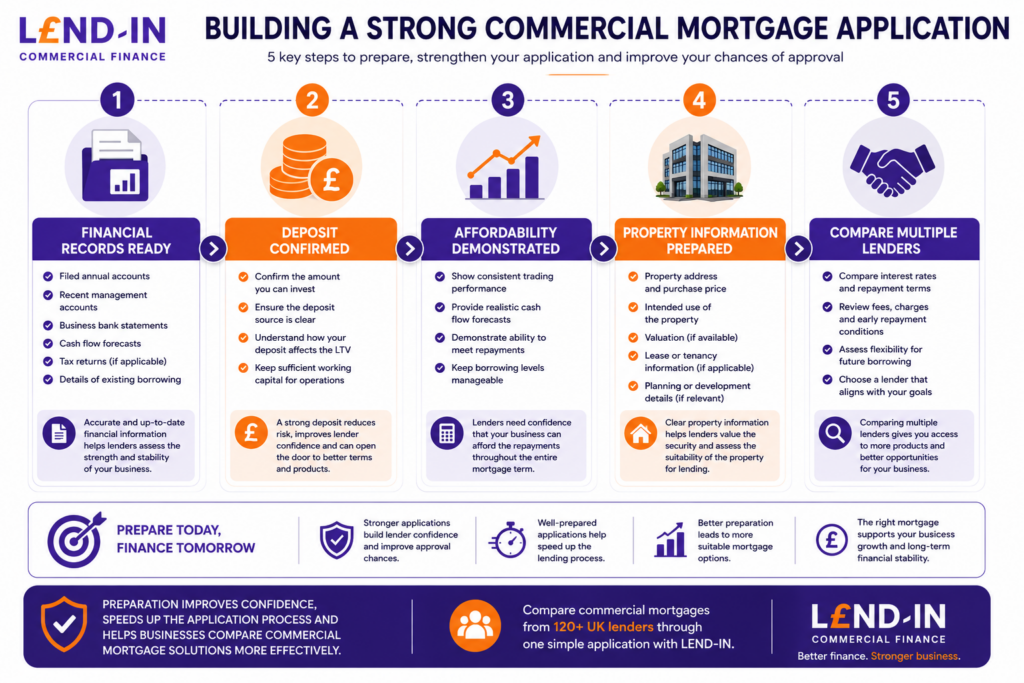
Table 3. Practical Ways to Strengthen a Commercial Mortgage Application
| Preparation Step | Why It Matters |
|---|---|
| Organise financial records | Demonstrates financial stability and supports underwriting. |
| Save an appropriate deposit | Reduces loan-to-value and strengthens the application. |
| Demonstrate sustainable cash flow | Helps prove affordability over the mortgage term. |
| Prepare property information | Enables accurate valuation and assessment. |
| Compare multiple lenders | Improves access to suitable mortgage products. |
| Define your property strategy | Helps select the right mortgage structure. |
Table 3. Practical steps businesses can take before applying for a commercial mortgage.
💼 Real-World Example
A growing accountancy practice plans to purchase larger office premises after expanding its client base. Before approaching lenders, the directors update their financial accounts, prepare cash flow forecasts, confirm the deposit source and obtain detailed information about the property.
By submitting a complete and well-organised application, the business enables lenders to assess affordability more efficiently and compare mortgage options that support its long-term expansion plans.
📊 Industry Insight
Strong commercial mortgage applications are typically built on preparation rather than speed. Businesses that organise their finances, understand their borrowing requirements and compare lenders thoroughly often experience a smoother application process and gain access to a broader range of funding options.
⭐ Expert Tip
Before submitting your application, review it from a lender’s perspective. Ask yourself whether the financial information, repayment strategy and purpose of the property purchase are clearly explained. A well-presented application can create a stronger first impression and reduce unnecessary delays.
✅ Key Takeaway
A successful commercial mortgage application is built on preparation. Accurate financial records, a realistic deposit, sustainable affordability and a clearly defined property strategy can strengthen your application while helping you identify the most appropriate funding solution.
Common Commercial Mortgage Myths Explained
Despite being one of the most established forms of commercial property finance, commercial mortgages are often misunderstood. Many business owners assume they are only available to large companies, believe deposits are always prohibitively high or think approval is based solely on business turnover.
In reality, commercial mortgage lenders assess applications using a combination of factors, including affordability, business performance, property value, deposit size and the intended use of the property. Requirements vary between lenders, meaning businesses with different trading histories and funding objectives may still have access to suitable commercial mortgage solutions.
Understanding the facts behind these common misconceptions helps businesses compare mortgage products more effectively while making informed decisions about financing commercial property.
Figure 7. Common Commercial Mortgage Myths vs Facts
This illustration compares common misconceptions about commercial mortgages with the facts. Understanding how commercial mortgage lending works enables businesses to make informed property finance decisions while comparing suitable funding options with greater confidence.
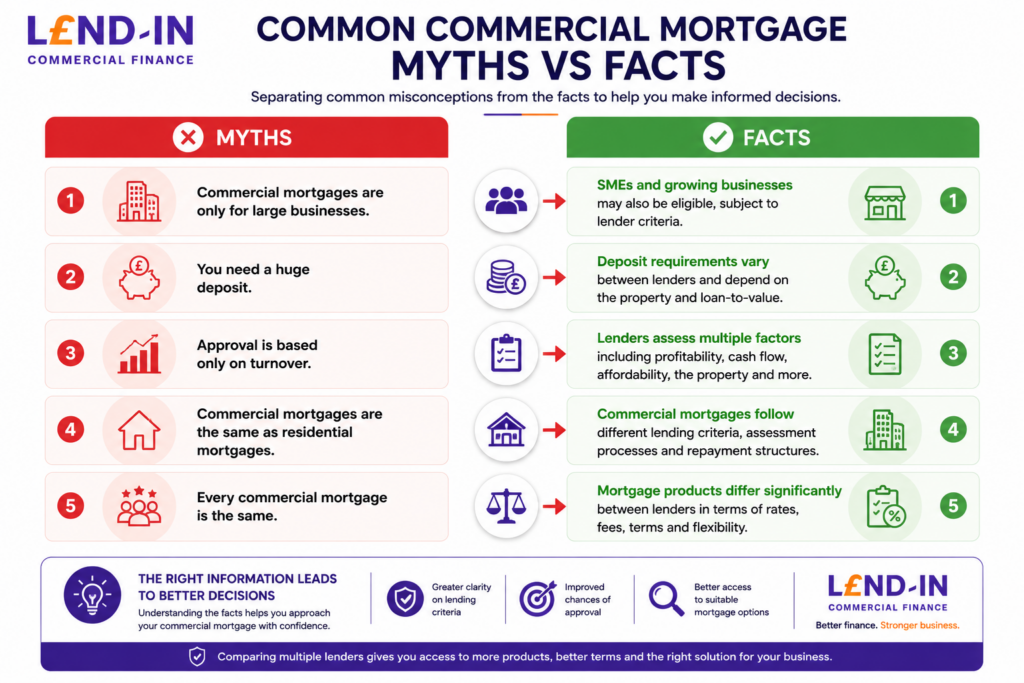
Myth 1: Commercial Mortgages Are Only for Large Businesses
Fact: Commercial mortgages are used by businesses of many sizes, including SMEs, family-owned companies and growing businesses. Eligibility depends on affordability, the property, the deposit and the lender’s criteria rather than business size alone.
Myth 2: You Need a Huge Deposit
Fact: Deposit requirements vary between lenders and depend on the type of property, loan-to-value ratio and overall risk profile. Some businesses may require larger deposits than others, but there is no universal requirement that applies to every application.
Myth 3: Approval Is Based Only on Turnover
Fact: Lenders consider a broad range of factors including profitability, cash flow, affordability, property valuation, management experience, credit history and the purpose of the purchase.
Myth 4: Commercial Mortgages Are the Same as Residential Mortgages
Fact: Commercial mortgages are designed specifically for business or investment property and are assessed using different lending criteria, repayment structures and affordability measures.
Myth 5: Every Commercial Mortgage Is the Same
Fact: Commercial mortgage products differ considerably between lenders. Interest rates, repayment terms, fees, loan-to-value limits and eligibility requirements all vary, making comparison an important part of the decision-making process.
Table 4. Commercial Mortgage Myths vs Facts
| Common Myth | The Reality |
|---|---|
| Commercial mortgages are only for large businesses. | SMEs and growing businesses may also be eligible, subject to lender criteria. |
| You always need a very large deposit. | Deposit requirements vary between lenders and property types. |
| Turnover is the only thing lenders assess. | Lenders review affordability, cash flow, the property and other financial factors. |
| Commercial mortgages are the same as residential mortgages. | Commercial lending follows different criteria and assessment processes. |
| Every lender offers the same mortgage. | Products, rates, repayment terms and lending criteria vary across the market. |
Table 4. Common misconceptions about commercial mortgages and the facts businesses should understand before applying.
💼 Real-World Example
A family-owned engineering business assumes it cannot qualify for a commercial mortgage because it has fewer than 20 employees. After comparing lenders, the directors discover that several providers focus on affordability, profitability and the value of the property rather than company size alone. The business secures funding to purchase its own premises, reducing long-term leasing costs while building equity in a commercial asset.
📊 Industry Insight
Commercial mortgage lending is far more flexible than many business owners realise. Different lenders specialise in different sectors, property types and borrower profiles, meaning comparing multiple providers can often reveal funding opportunities that may not be apparent when approaching a single lender.
⭐ Expert Tip
Don’t make assumptions based on someone else’s experience. Every commercial mortgage application is assessed individually, so comparing multiple lenders and understanding their criteria can significantly improve your chances of finding a suitable funding solution.
✅ Key Takeaway
Many common beliefs about commercial mortgages are based on misconceptions rather than current lending practices. Understanding how lenders assess applications and comparing multiple providers helps businesses make informed property finance decisions with greater confidence.
Is a Commercial Mortgage Right for Your Business?
A commercial mortgage can be an effective way for businesses to purchase, refinance or invest in commercial property while spreading the cost over an agreed repayment period. However, it is not the most appropriate funding solution for every business or every property transaction.
The right choice depends on your commercial objectives, financial position and the purpose of the property. Businesses purchasing premises to operate from may have different priorities to investors seeking rental income, while organisations acquiring mixed-use properties often require specialist lending solutions.
Before applying for a commercial mortgage, it is important to assess whether property ownership aligns with your long-term strategy. Factors such as affordability, expected occupancy, future expansion plans and the availability of working capital should all form part of the decision-making process.
Taking time to evaluate these considerations before comparing lenders helps businesses identify funding that supports sustainable growth while avoiding unnecessary borrowing.
A Commercial Mortgage May Be Suitable If Your Business…
A commercial mortgage may be appropriate if your business:
- Plans to purchase commercial premises rather than continue renting.
- Wants to build long-term equity in a business asset.
- Has a sustainable income to support regular mortgage repayments.
- Can provide an appropriate deposit, subject to lender criteria.
- Requires long-term property finance for business growth.
- Intends to remain at the property for the foreseeable future.
- Is purchasing commercial property as an investment.
A Commercial Mortgage May Be Less Suitable If…
Alternative funding solutions may be worth considering if:
- Your business only requires premises for a short period.
- Leasing provides greater operational flexibility.
- The property purchase does not align with your long-term strategy.
- Preserving working capital is a higher priority than property ownership.
- Another commercial finance product better supports your funding objective.
Understanding the purpose of the property purchase before selecting a funding solution helps ensure your financing strategy aligns with the wider goals of the business.
Figure 8. Is a Commercial Mortgage Right for Your Business?
This decision framework helps UK businesses assess whether a commercial mortgage aligns with their property requirements and long-term objectives. By considering affordability, business strategy and intended property use, businesses can compare suitable funding solutions with greater confidence.
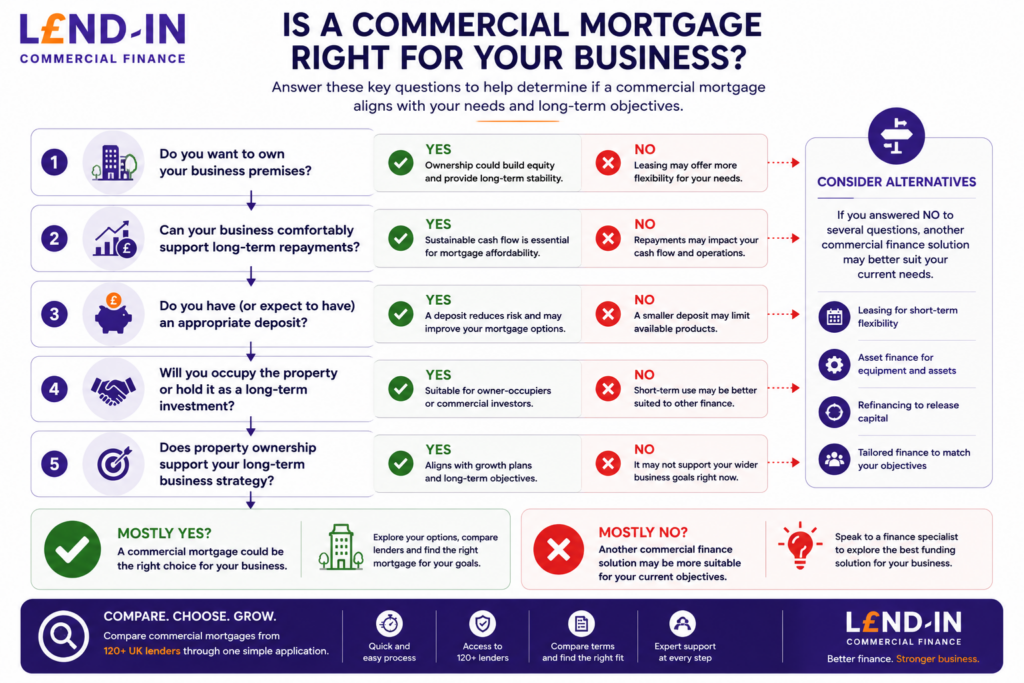
Table 5. Businesses That Commonly Use Commercial Mortgages
| Business Type | Typical Purpose |
|---|---|
| Manufacturers | Purchase factories and industrial units. |
| Retailers | Buy high street shops and retail premises. |
| Professional Services | Acquire office space. |
| Healthcare Providers | Purchase surgeries and clinics. |
| Hospitality Businesses | Buy hotels, restaurants and leisure venues. |
| Logistics Companies | Acquire warehouses and distribution centres. |
| Commercial Property Investors | Build commercial property portfolios. |
Table 5. Examples of businesses that commonly use commercial mortgages.
💼 Real-World Example
A successful veterinary practice has rented its premises for several years but now wishes to establish a permanent base. After reviewing its financial position and future growth plans, the practice secures a commercial mortgage to purchase the property. This provides greater certainty over occupancy costs while allowing the business to build equity in a valuable long-term asset.
📊 Industry Insight
Many established UK businesses eventually transition from leasing to owning commercial premises as they grow. While leasing can provide flexibility, ownership may offer greater long-term control over occupancy costs and create an asset that strengthens the business’s balance sheet.
⭐ Expert Tip
Before deciding to purchase commercial property, compare the long-term financial implications of ownership against continued leasing. Consider not only monthly repayments but also maintenance, insurance, taxes and future expansion plans to ensure the property supports your wider business strategy.
✅ Key Takeaway
A commercial mortgage can be an excellent long-term funding solution for businesses seeking to own commercial property. Assessing your business objectives, financial position and property strategy before comparing lenders helps ensure you select the most appropriate finance solution.
How Lend-In Helps Businesses Compare Commercial Mortgages
Comparing commercial mortgages can be time-consuming, particularly as lenders vary in their eligibility criteria, loan-to-value limits, repayment structures, fees and interest rate options. Understanding which lender is most appropriate often requires businesses to compare multiple providers rather than relying on a single mortgage offer.
At Lend-In, we simplify this process by enabling businesses to compare commercial mortgage solutions from more than 120 UK lenders and finance providers through one straightforward application.
Whether you’re purchasing your first business premises, refinancing an existing commercial mortgage, investing in commercial property or acquiring a mixed-use building, our aim is to help you explore funding solutions that align with your business objectives and long-term property strategy.
Because every lender assesses applications differently, comparing a broad panel of providers can improve visibility across the market while helping businesses identify commercial mortgage solutions that reflect their financial circumstances, deposit, affordability and property requirements.
Our commercial finance specialists support businesses throughout the comparison process, helping them understand the differences between lenders, evaluate available options and make informed funding decisions with confidence.
Businesses We Commonly Help
Commercial mortgages are used across a wide range of industries and sectors.
We regularly help businesses compare funding for:
- Manufacturing businesses.
- Professional service firms.
- Retailers.
- Healthcare providers.
- Hospitality businesses.
- Logistics and distribution companies.
- Commercial property investors.
- Engineering businesses.
- Technology companies.
- Growing SMEs purchasing their first commercial premises.
Every application is assessed individually, and available funding depends on the lender’s criteria, the property, affordability and the overall circumstances of the applicant.
Why Businesses Compare Commercial Mortgages Through Lend-In
Businesses choose Lend-In because we focus on helping them compare suitable funding solutions rather than directing them towards a single lender.
Our comparison process includes:
- Comparing commercial mortgages from 120+ UK lenders and finance providers.
- Access to a wide range of owner-occupied, investment and semi-commercial mortgage products.
- Guidance from experienced commercial finance specialists.
- A straightforward application process.
- Funding solutions tailored to individual business requirements.
- Ongoing support throughout the comparison journey.
By comparing multiple providers through one application, businesses gain greater visibility of the market while identifying funding that aligns with both their immediate property purchase and long-term commercial objectives.
Figure 9. The Lend-In Commercial Mortgage Comparison Journey
This illustration demonstrates how Lend-In simplifies the commercial mortgage comparison process. By understanding your property requirements, comparing funding from more than 120 UK lenders and presenting suitable mortgage options, businesses can make informed property finance decisions that support long-term growth.
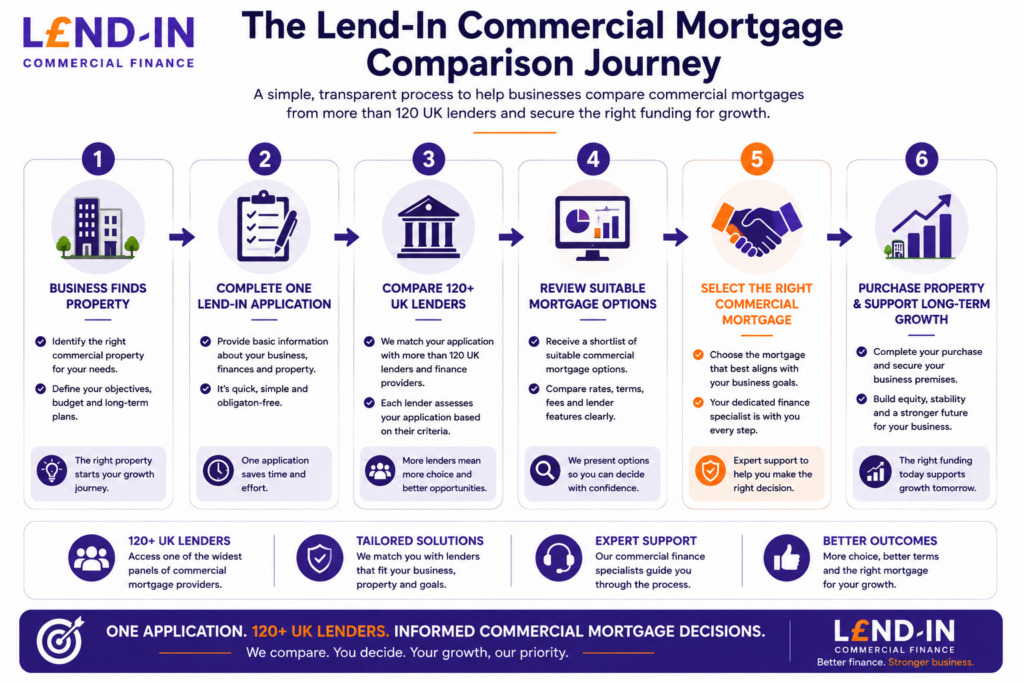
💼 Real-World Example
A successful manufacturing company decides to purchase a larger industrial unit after outgrowing its existing premises. Rather than approaching lenders individually, the directors submit a single application through Lend-In.
After comparing commercial mortgage options from a broad panel of UK lenders, the business reviews suitable funding solutions and selects a mortgage that aligns with its affordability, deposit and long-term expansion plans.
📊 Industry Insight
Commercial mortgage providers often specialise in different sectors, property types and borrower profiles. Comparing multiple lenders increases the likelihood of identifying funding that reflects the specific needs of the business rather than relying on a single lending decision.
⭐ Expert Tip
When comparing commercial mortgages, look beyond the headline interest rate. Consider repayment flexibility, arrangement fees, early repayment charges, loan-to-value limits and how well the mortgage supports your long-term business strategy.
✅ Key Takeaway
Comparing commercial mortgage providers gives businesses greater choice, improved visibility of the market and a better opportunity to secure funding that reflects their individual circumstances. A single comparison can save time while helping identify a mortgage solution that supports sustainable business growth.
Frequently Asked Questions
A commercial mortgage is a type of business finance used to purchase, refinance or release equity from commercial property. Businesses repay the borrowing over an agreed term, with the property usually serving as security for the loan.
A lender provides funding towards the purchase or refinance of commercial property. The borrower typically contributes a deposit, with the remaining balance repaid through regular monthly instalments over an agreed period.
Commercial mortgages can be used to finance a wide variety of properties, including:
– Offices.
– Retail premises.
– Warehouses.
– Industrial units.
– Medical practices.
– Hotels.
– Mixed-use buildings.
– Commercial investment properties.
Commercial mortgages are designed for business or investment properties and are assessed using commercial lending criteria. Residential mortgages are intended for owner-occupied homes and follow different affordability and regulatory requirements.
Deposit requirements vary between lenders and depend on factors such as the property type, loan-to-value ratio, business circumstances and overall lending risk.
Yes. Many lenders consider applications from SMEs, family-owned businesses and growing companies, provided they meet the lender’s affordability and eligibility criteria.
Lenders commonly assess:
– Business turnover.
– Profitability.
– Cash flow.
– Deposit size.
– Property valuation.
– Loan-to-value ratio.
– Credit profile.
– Existing borrowing.
– Director experience.
– Affordability.
Yes. Owner-Occupied Commercial Mortgages are specifically designed for businesses purchasing premises from which they intend to operate.
Yes. Commercial Investment Mortgages are commonly used to purchase offices, retail units, industrial buildings and other commercial properties that will generate rental income.
A semi-commercial mortgage is designed for properties containing both commercial and residential elements, such as shops with flats above or mixed-use developments.
Timescales vary depending on the lender, property type, valuation process and legal work involved. Providing complete financial information and responding promptly to requests can help reduce delays.
Many lenders offer both fixed-rate and variable-rate commercial mortgages. The most suitable option depends on the business’s appetite for interest rate risk, cash flow requirements and long-term financial strategy.
Yes. Businesses may refinance an existing commercial mortgage to secure different repayment terms, access additional borrowing or release equity, subject to lender approval.
In addition to the purchase price and deposit, businesses should consider:
– Valuation fees.
– Legal fees.
– Stamp Duty Land Tax (where applicable).
– Arrangement fees.
– Survey costs.
– Ongoing maintenance.
– Insurance.
Some lenders consider newer businesses, although eligibility depends on factors such as the directors’ experience, deposit, business plan, affordability and the proposed property.
For many businesses, owning premises provides greater long-term certainty over occupancy costs and enables them to build equity in a commercial asset. Whether ownership is appropriate depends on the business’s objectives and financial circumstances.
Commercial mortgage products vary in terms of interest rates, fees, repayment structures, loan-to-value limits and eligibility criteria. Comparing multiple providers helps businesses identify funding that aligns with their individual requirements.
Potential advantages include:
– Long-term property ownership.
– Building equity over time.
– Greater control over business premises.
– Predictable repayment structures.
– Supporting business growth through property investment.
Not necessarily. Businesses should consider affordability, future plans, property strategy and working capital before deciding whether purchasing commercial property is more appropriate than leasing or another funding solution.
Lend-In enables businesses to compare commercial mortgage solutions from more than 120 UK lenders and finance providers through one straightforward application. Our specialists help businesses understand available options, compare lenders and make informed property finance decisions based on their individual objectives.
Conclusion: Understanding Commercial Mortgages for Long-Term Business Success
Purchasing commercial property is one of the most significant financial decisions a business can make. Whether acquiring premises to operate from, investing in commercial property or refinancing an existing asset, selecting the right funding solution requires careful planning, a clear understanding of business objectives and informed decision-making.
As this guide has explored, a commercial mortgage enables businesses to spread the cost of purchasing or refinancing commercial property over an agreed repayment period while preserving valuable working capital for day-to-day operations and future investment. By financing property in a structured and sustainable way, businesses can establish greater long-term stability, strengthen their balance sheet and create opportunities for future growth.
However, commercial mortgages are not a one-size-fits-all solution. Owner-Occupied Commercial Mortgages, Commercial Investment Mortgages and Semi-Commercial Mortgages each serve different purposes and are assessed using different lending criteria. Understanding these distinctions before applying allows businesses to compare products more effectively and select funding that reflects both their immediate requirements and their wider commercial strategy.
Preparation also plays a vital role in a successful application. Maintaining accurate financial records, demonstrating sustainable affordability, preparing comprehensive property information and understanding lender expectations can significantly improve the quality of an application. Equally important is comparing multiple commercial mortgage providers rather than relying on a single lender, as products, eligibility criteria, repayment structures and fees vary across the market.
At Lend-In, we believe businesses achieve better outcomes when they fully understand their funding options. By comparing commercial mortgage solutions from more than 120 UK lenders and finance providers, we help businesses explore a broad range of property finance options through one straightforward application, supported by experienced commercial finance specialists throughout the comparison process.
Ultimately, a commercial mortgage is about more than purchasing a building. When structured appropriately, it provides businesses with an opportunity to establish long-term premises, build equity in valuable commercial assets and create a stronger financial foundation for future success. Taking the time to understand how commercial mortgages work, preparing thoroughly before applying and comparing suitable lenders can help businesses make informed property finance decisions with confidence.
✅ Final Takeaway
A commercial mortgage enables businesses to purchase, refinance or invest in commercial property while spreading repayments over time. By understanding the different mortgage types, preparing a strong application and comparing multiple lenders, businesses can secure funding that supports long-term stability, sustainable growth and informed commercial property investment.
Continue Your Learning
If you found this guide helpful, explore our other expert resources designed to help UK businesses better understand commercial finance and make informed funding decisions.
The Lend-In Commercial Finance Knowledge Centre provides practical, evidence-based guidance on business funding, commercial property finance, cash flow management and commercial lending, helping businesses compare finance solutions with confidence.
Business Funding
Business Finance Explained: The Complete Guide for UK Businesses
Discover how business finance works, compare funding products and understand how UK businesses can identify finance solutions that support sustainable long-term growth.
Best for: Businesses exploring funding for the first time.
Commercial Finance Explained: The Complete Guide for UK Businesses
Learn how commercial finance works, explore different funding products and understand how businesses compare finance solutions for a wide range of commercial objectives.
Best for: Businesses comparing multiple funding options.
Business Loans Explained: The Complete Guide for UK Businesses
Understand secured and unsecured business loans, lender assessment criteria and practical ways to improve your chances of approval.
Best for: Businesses seeking structured borrowing for growth and investment.
Property & Asset Finance
Asset Finance Explained: The Complete Guide for UK Businesses
Explore how asset finance enables businesses to purchase equipment, vehicles and machinery while protecting working capital.
Best for: Businesses investing in commercial assets.
Invoice Finance Explained: The Complete Guide for UK Businesses
Learn how invoice finance improves cash flow by releasing funds tied up in unpaid customer invoices.
Best for: Businesses trading on credit terms.
Equipment Finance Explained (Coming Soon)
Understand how equipment finance helps businesses invest in essential machinery and technology while spreading the cost over time.
Cash Flow & Working Capital
Working Capital Explained: The Complete Guide for UK Businesses
Discover how working capital supports day-to-day trading, improves liquidity and strengthens long-term financial stability.
Best for: Businesses focused on improving cash flow.
Business Cash Flow Explained (Coming Soon)
Learn practical techniques for forecasting, managing and improving business cash flow.
Commercial Property & Growth
Commercial Property Finance Explained (Coming Soon)
Explore the different ways businesses finance commercial property purchases, refinancing and expansion.
Commercial Property Investment Explained (Coming Soon)
Understand the principles of commercial property investment, rental income, yield and long-term portfolio growth.
Refinancing Commercial Property Explained (Coming Soon)
Learn when refinancing may be appropriate, how lenders assess applications and the factors businesses should consider before refinancing commercial property.
Business Credit Scores Explained (Coming Soon)
Understand how commercial credit profiles influence lender decisions and discover practical ways to strengthen your business creditworthiness.
Why Business Finance Applications Are Declined (Coming Soon)
Explore the most common reasons funding applications are declined and learn practical steps to improve future applications.
📚 Explore the Lend-In Commercial Finance Knowledge Centre
Every guide within the Lend-In Commercial Finance Knowledge Centre is written to help UK businesses understand commercial finance, compare funding products and make informed decisions with confidence. Whether you’re purchasing commercial property, improving cash flow or planning long-term expansion, our educational resources are designed to support your business at every stage of its funding journey.
References
The following organisations publish authoritative guidance, research and statistics relating to commercial mortgages, commercial property, business lending and UK commercial finance.
- British Business Bank. Small Business Finance Markets Report. Available at: https://www.british-business-bank.co.uk
- Financial Conduct Authority (FCA). Business Lending and Consumer Guidance. Available at: https://www.fca.org.uk
- Bank of England. Money and Credit Statistics. Available at: https://www.bankofengland.co.uk
- UK Finance. Business Finance and Lending Publications. Available at: https://www.ukfinance.org.uk
- HM Revenue & Customs (HMRC). Business Tax and Property Guidance. Available at: https://www.gov.uk/government/organisations/hm-revenue-customs
- Companies House. Guidance for UK Companies. Available at: https://www.gov.uk/government/organisations/companies-house
- Department for Business and Trade. Business Support and Commercial Guidance. Available at: https://www.gov.uk/government/organisations/department-for-business-and-trade
- Institute of Chartered Accountants in England and Wales (ICAEW). Business Finance and Commercial Property Resources. Available at: https://www.icaew.com
- Royal Institution of Chartered Surveyors (RICS). Commercial Property Standards and Valuation Guidance.Available at: https://www.rics.org
- Office for National Statistics (ONS). UK Business and Property Statistics. Available at: https://www.ons.gov.uk
- British Chambers of Commerce. Business Growth and Economic Insights. Available at: https://www.britishchambers.org.uk
- Lend-In Commercial Finance Knowledge Centre. Educational resources covering business finance, commercial finance, commercial mortgages, asset finance, invoice finance and working capital. Available at: https://lend-in.io